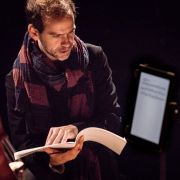
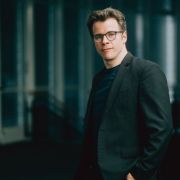
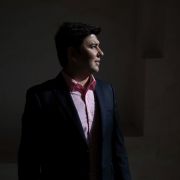
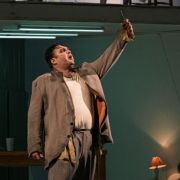
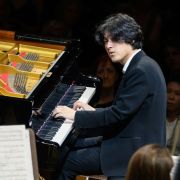
The Czech Philharmonic debuted its new composer-in-residence position this season with an unlikely choice: Bryce Dessner, an American rock star who has developed a successful parallel career as a classical music and film soundtrack composer. Dessner joined the orchestra onstage for the first time with fellow guitarist David Chalmin for the Czech premiere of St Carolyn by the Sea, a piece inspired by the Jack Kerouac novel Big Sur. Moody and tense, it set the tone for an evening of provocative music.

Kerouac was in a bad way when he wrote Big Sur, struggling with alcoholism and a mental breakdown. Dessner’s piece reflects that, with tense strings that start softly and gradually whip up to a fever pitch. Sounds of the sea – pounding surf, ships’ bells, a foghorn – set a melancholy mood broken only in the final moments by a sharp, surging finish. The guitars were muted, emerging from the full orchestral sound for just two brief solos that Dessner and Chalmin used to create contrasting sonics. With Jakub Hrůša on the podium, the orchestra gave the music a cinematic quality ideal for bringing atmospheric seascapes to life.


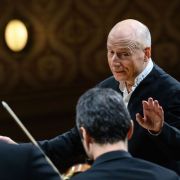
St Carolyn was paired with Britten’s Four Sea Interludes from his opera Peter Grimes, which Hrůša rendered in fine detail. Bubbles, birds and chimes sparkled in the first two movements, then gave way to the agitated drama of Moonlight and a vivid, high-impact Storm finale. Hrůša showed tight control in bringing clarity to the tumult and heft to the early, lighter moments. A bit less volume would have added more ambience, but his treatment gave the piece a driving, irresistible momentum.
While Dessner may have been the headliner, the real star of the evening was Josef Suk, whose music opened and closed the program. A noted Czech violinist, composer – and son-in-law of Antonín Dvořák – Suk is a personal favorite of Hrůša, who handles his work with loving care. His expertise with Suk’s music was clear in both an opening triptych and the concluding symphonic poem Praga.
The triptych opened with Meditation on the Old Czech Corale “St Wenceslas”, a nationalistic piece that Hrůša imbued with great depth of feeling. Legend of the Death Victors, a paean to fallen Czech legionnaires, was fervent and richly expressive, featuring a nifty stand-up turn by the trumpeters. Toward a New Life offered a spirited interpretation of a festive march, anchored by precision sequences between the brass and percussion. There was a pride in the playing that extended to the audience, which responded with lively enthusiasm.


Praga is a romantic fantasia that opens in a pastoral mode and builds to emotional swells colored by bright horns and brass. Hrůša teased out the melodies at first gently, then with bold strokes that gave the music large, nearly overpowering dimensions. It was almost too much at times, like a demand for attention that was impossible to ignore. But the performance was heartfelt and the playing crisp and fine-tuned, a skillful combination of passion and technical expertise.
The piece has a tricky stop-and-start ending that left Hrůša red-faced with exertion and smiling broadly at the impeccable execution. He lingered during the applause, making his way through the orchestra to congratulate what is essentially a group of old friends. Starting with the 2028-29 season, Hrůša will take over as Chief Conductor of the orchestra, and in both style and bearing this evening was very much the heir apparent.