Having an orchestra premiere your music is a high compliment to any composer. Having it happen twice in two seasons is higher still. Yet that’s what has happened with Elena Langer and the Royal Scottish National Orchestra. I confess, however, that I’m struggling to see what the orchestra’s management finds so attractive about her music: I didn’t love last season’s premiere, a bitty and unsatisfying setting of Edward Lear’s The Dong With a Luminous Nose, and I wasn’t that enamoured of this season’s either.

The Lives of Birds is a cycle of eight songs written to poems by Glyn Maxwell, poems that imagine the private lives of birds who have human foibles just like ours, but whose brief lives are lived in constant fear of their nemesis, the white cat. It’s a great idea for a song cycle, but Maxwell’s playful language only intermittently marries up with the mood of Langer’s music. Sometimes it’s straightforwardly pictorial, such as the dissonant buzz of the white cat whenever it appears in the text, or the inevitable chirruping woodwind that you’d expect when it comes to bird music. Elsewhere, however, the mood swings between music of twee storybook innocence, hulking dance rhythms or throbbing tintinnabulations, and I was only rarely convinced by Langer’s musical choices. Only occasionally was it clear why she chose one orchestral colour or technique over a different one, and much of the music seemed somewhat arbitrary and rarely memorable.


The orchestra gave it the finest birth you could imagine, and soprano Anna Dennis sang with great commitment, particularly in the third song when her wavering voice caught effectively the tone of the undulating orchestral picture. Problems of balance, however, meant that it was frequently difficult to hear her over the orchestra; an occupational hazard with a world premiere, but unfortunate nonetheless.
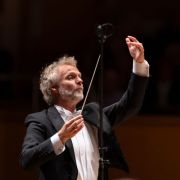
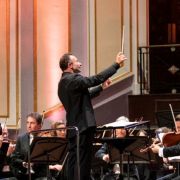
Far finer things lay elsewhere in the programme, not least a weighty, sonorous performance of Pärt’s Cantus in Memoriam Benjamin Britten, which began with glassy shards of sound hovering in mid-air, slowly coalescing around a bass line that was drawn infinitely downwards like an Escher picture. Much of the credit for that lay with the control exerted from the podium by Kristiina Poska, a powerhouse conductor returning to the RSNO for the first time since her first rate Sibelius in 2003.
She was also responsible for a gripping Tchaikovsky 4 that was as tight as a coiled spring. The opening fanfare was as clear, curt and clipped as you’d like it to be, and the main Allegro was vibrant and propulsive, full of dark energy that drove it forwards, the second subject having the lilt of the dance like a lopsided waltz. Poska controlled the change of tempo with remarkable skill, driving the movement towards a furious coda, which was just a preparation for an exciting finale that swung between despair and euphoria. En route, the slow movement had the lyricism of a song-without-words, and the Scherzo was taken so daringly quickly that it felt like it was at permanent risk of collapse. It’s a testament to the players that it never did.