Staging a Ring cycle is the pinnacle for any major opera house; the resources, the continuity and sheer musical demands placed upon a company are significant, which makes it the more impressive when one of our country house opera festivals is taking on such a challenge. The challenger energy of Grange Park Opera under the inimitable Wasfi Kani has led to the contracting of the Orchestra of English National Opera to perform Wagner’s Ring – a second attempt after the suspension of ENO’s own cycle midway through – launched this summer with the first of the four works, Das Rheingold.

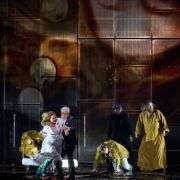
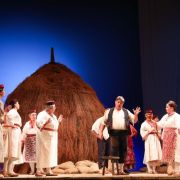
In many respects, Charles Edwards’ production is uncontroversial and plays into older trends of Marxist readings of the work. The gods are upper class, decked out in pristine Victorian white frocks and three-piece suits, enjoying their stylishly monochrome surroundings where space is a luxury. They are casual in their breaches of contract, relying on superiority to get one over on the honest worker, the giants, stiff and formal in their brown flannel, but eager for the respect that their labour deserves.


Alberich is transformed here from the ordinary working man – a brief moment before the prelude begins gives hints of something reminiscent of a solider or miner – into the ultimate capitalist who brutalises his workers, the ultimate Marxist nightmare clad in garish check trousers. The depiction of Mime’s torture is perhaps the most bracing moment of the evening: the elderly figure is trapped in a metal cage which Alberich electrifies with cables, prompting screams of anguish. Edwards, who also designed the set, relies heavily on a transparent curtain, onto which is projected Valhalla and striking anvils, but which also allows, through games of light and shadow, to depict Alberich’s transformations through the Tarnhelm. It’s a production with plenty to relish, from the suggestion that much of Alberich’s anger stems from jokes about his penis size – the words “pimpled dwarf” uttered when staring down his trousers – to the suggestion of romance, either Stockholm-based or real between Freia and Fasolt. With the exception of a gag about a fuse-box which never completely took off, Edwards gets pretty much everything right, including its casting.

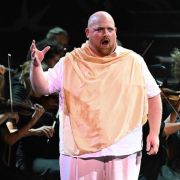
The production hinges on a magnificent performance by David Stout as Alberich. Stout’s baritone is big, but beautifully coloured, with a focus on the text that informed everything he did. Once or twice, there was a wobble towards caricature, but Stout always brought it back, giving us an acutely psychological reading of a fascinating character. His greed, his rage, his pride and ultimately his humiliation were depicted with flair; with no disrespect to his colleagues, this production belongs to him. As Wotan, James Rutherford occasionally weakened towards the end of a line but showed a resonant, slightly lyrical bass-baritone. In contrast to Stout’s emotional Alberich, he brought imperious stolidity to Wotan.


Completing the central trio, Mark Le Brocq brought a pale and incisive tenor to Loge; as a demi-god, no white finery for him, but a black smock with fiery hair and the kind of spectacles that scream of small print and morally questionable decisions. Le Brocq’s voice is not huge, but the role is wordy and Le Brocq brought a sense of narrative to his phrasing that suited the character. Among the smaller roles, Matthew Rose brought his trademark sensitivity and depth to Fasolt – nuanced in his dramatic portrayal, and that sense of poetry to his singing, all underwritten by his ebony bass, while Christine Rice’s coppery mezzo-soprano was thoughtfully deployed as a sophisticated and perspicacious Fricka. James Schouten displayed a bright and ringing tenor to Froh, juxtaposed against the darker tones of Thomas Isherwood’s Donner. Special note to Adrian Thompson whose acting as Mime showed depth, accompanied by a forceful vocal display in the higher register when he brings the gold and witnesses his tormentor shackled.

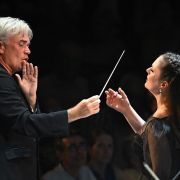
In the pit, Harry Sever led ENO’s orchestra in a lithe reading of the score, eschewing any sense of the ponderous. Brass occasionally veered towards the strained, but the string colour was rich and Sever emphasised melody and drama. Grange Park Opera really is to be commended on an excellent start to this most enterprising endeavour.