During his life, Wolfgang Rihm was labeled as (or accused of being) a composer of new simplicity, new subjectivity, neo-Romanticism and neo-Expressionism, among other appellatives. He generally rejected any such labeling but sometimes favored the term “new multiplicity”, which might be more appropriate if only because any two or three of the others might be going on at the same time in his work. At least in the case of his Jagden und Formen, in any event, in which there is also the multiplicity of interpolating other of Rihm’s works into the score, adding a new dimensionality, at the risk of coining a phrase.


Jagden und Formen (Hunts and Forms) has existed in two previous versions, each of which was performed in New York City. The earliest, from 1996, was played by Frankfurt’s Ensemble Modern when Thomas Fichter was the group’s bassist. Fichter is now artistic director of the Times:Spans Festival, an essential summer run of new music in New York City put on by the Earle Brown Music Foundation Charitable Trust. The 2008 version of the work opened this year’s festival on 8th August in its New York premiere, performed by the excellent Talea Ensemble and adding another layer to the Rihm cake.
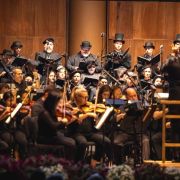
The work is scored for a small orchestra of paired instruments and, at least on Saturday, doubling players (24 in all). Small subgroupings, often stacked atop one another, made for an intimate but also bold concert. It started with a single group clap from the ensemble, then a violin duet with deep bass underpinnings added in short order, and proceeded at hyper, polyrhythmic paces: brash percussion and insistent piano; a frantic string quintet and a cutting wind ensemble; a staggering section for oboe and flute versus harp and vibraphone, all in metric discontent like a promenade through a prism. The rush of Shostakovich ran tandem with the tension of Bernard Hermann alongside the sound of a dozen practice rooms in a university music building. It all fell together like schizophrenic clockwork and was gripping enough to make the moments of relative calm feel like release. They weren't: they were just moments, brief moments of a little bit less. But the very occasional reductions were nearly paralyzing.


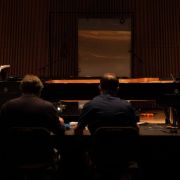
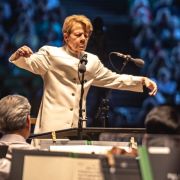
The concert was a dizzying, hour-long, single-movement display, held together by conductor James Baker but also by a nearly tangible focus among the ensemble in a piece that is exhausting even to listen to. Credit should also be given to the wood-lined, acoustically pristine room at the Dimenna Center for Classical Music, which does double duty as a recording studio. The Center will host Time:Spans through the 22nd, although Jagden und Formen alone seemed festival enough.