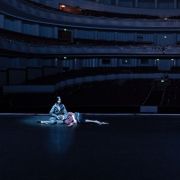
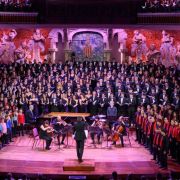
A new production of the only major stage work written by one of the most important composers of the 20th century, with a top-notch cast and a talented young conductor on the podium, is most certainly an event to die for. Or not? As part of the celebrations for the 75th anniversary of the Berliner Festspiele, Musikfest Berlin opened at the Philharmonie with a semi-staged version of Ligeti’s Le Grand Macabre, borrowing production, cast and conductor Nicholas Collon from the concomitant Helsinki Festival. What was predicted to be quite literally out of this world, however, remained grounded by Frederic Wake-Walker's unconvincing directorial choices.

The idea of semi-staging an opera that has alienation and absurdity as its tenets is, in principle, a good one. In tried and tested Brechtian fashion, Wake-Walker uses the entirety of the concert hall for singers, extras and musicians to move around freely, breaking the wall between fiction and reality. And yet, the staging quickly ran aground as soon as it tried to say more, getting stuck on the shore of productions whose only political jab is weakly directed to a fictional dictator vaguely modelled after Donald Trump. Surely Ligeti’s rich, caustic creation deserves better than easy ways out. This happened to align with the evening’s opening statement, which remarked that art has no obligation to be political – a puzzling way to introduce Le Grand Macabre of all operas, drawing as it does on Ligeti’s experience as a Holocaust survivor and political refugee. Ultimately, the production stayed afloat thanks to some strong performances from the cast, who proved confident on stage and just the right amount of lunatic.


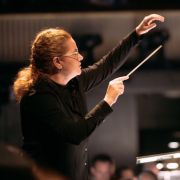
Better news came from the music front, where Collon sported great chemistry with his Finnish Radio Symphony Orchestra. Despite Ligeti’s homage to Pieter Bruegel the Elder (‘Breughelland’), the score of Le Grand Macabre rather resembles a Hieronymus Bosch painting, with its omnivorous tendency to absorb everything it meets and turn it into a story. Every moment in Collon’s rendition revealed a new facet of the orchestra, in a blend of timbres and textures that epitomised the very idea of pastiche. Grotesque exaggeration reigned over much of the performance: screeching, scorching sounds from the high register of the ensemble and cavernous, gaping frequencies from the low register; rhythmical patterns repeated obsessively, to the point of madness; percussion which went from the ethereal to the cartoonish in a split second. Collon somersaulted easily from Baroque hints to distorted Romantic sweeps. The apparent lack of logical nexuses and the suspension of contradictions are the direct result of music about and/or under censorship, where farcical nonsense provides an outlet if nothing can be said openly.

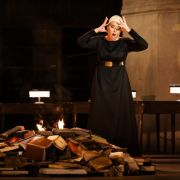
Ligeti’s approach to writing for voice is analogous, which has earned the work a reputation for near-impossible roles. As both Venus and the Chief of the Gepopo, Sarah Aristidou gave a taste of her misty, firm high notes in the first act, before u-turning to cascades of monosyllabic cypher which were stuttered, howled and – occasionally – sung in speedy coloratura. Wolfgang Ablinger-Sperrhacke's Piet the Pot succeeded in flaunting a soft and athletic tenor which also alternated between possibly any type of vocal emission known to humanity. Leigh Rose oscillated from prophet to gremlin as Nekrotzar thanks to a part-rough, part-imposing baritone and sprightly stage presence. Completing the cast between squawks and shrieks were soprano Heidi Melton, singing an oddly seductive, smug Mescalina, and bass Karl Huml as Astradamors, who navigated the frequent leaps between low register and falsetto incredibly gracefully.