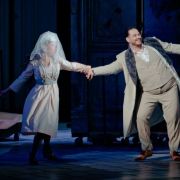
When a performance of Wozzeck cuts to the quick, it does so by killing us softly. From the brutal, half-true story and fragmentary form of Georg Büchner’s play, Alban Berg painstakingly fashioned a music-drama full of humour – sympathetic as well as sardonic – and a score touched with a flowing tenderness to match the operas of his contemporary, Puccini. It was the realisation of these, often under-rated elements to Wozzeck that defined the success of the London Philharmonic Orchestra’s concert staging at the Royal Festival Hall on Saturday.

The cast assembled was pretty much world class. As the Captain, and the first of Wozzeck’s tormentors, Peter Hoare brought to bear his 20-plus years of experience in the role. His pointed articulation gave us more of the notes than might have been anticipated, given his recent, expressionistic take on Mime in Siegfried at Covent Garden. His colleagues likewise resisted the temptation to slip into caricatured Sprechgesang. Brindley Sherratt brought tones of glowing coals to the Doctor and Christopher Ventris filled the Drum-Major’s pseudo-Wagnerian britches with muscular lyricism.


More captivating still was Annette Dasch’s full portrayal of Marie, her native German surely an advantage in this regard. Making a 12-tone lullaby sound like a lullaby is no small achievement, but conversational intimacy equally inflected her haughty chat with Margret (a strong cameo from Kitty Whately), her seduction and submission to the Drum Major, and her care and mounting fears for her partner. As Wozzeck, Stephane Dégout overcame the challenge of a role often reduced to gruff and inarticulate suffering. Much as in the role of Debussy’s Pelléas, identity has to be inferred from elusive and elliptical fragments of speech, and Dégout projected the quiet one-liners of resignation as powerfully as the dark and prophetic visions which isolate him from everyone else like an Old Testament prophet.

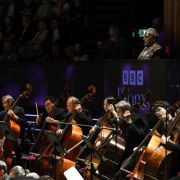
The soundworld of Wozzeck is defined by its Austro-German rhythms as much as its revolutionary harmony, and Edward Gardner kept marches and dances alike on their toes. Chamber-music delicacy and contrapuntal detail defines a score that rarely rises above a piano dynamic, and the London Philharmonic players responded to Gardner with a finesse all the more impressive in the context of a one-off performance. So many small miracles of invention on Berg’s part breathed as easily as Mozart, none more so than the ghostly Act 3 chorus of snoring soldiers.


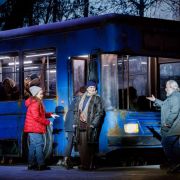
Above orchestra and singers, the stage was dominated by a screen playing out a straightforwardly updated version of the story as devised by Ilya Shagalov and his creative partner Nina Guseva. Unfolding for much of the time with a forensic police-drama photo-realism, Shagalov’s imagery replaced the military setting of the original with the scaffolding and tabards of a modern building site. Signs of AI struck a false note here and there; more problematic was the visual absence of the child on whom the drama often hinges. On this occasion, our unnamed boy appeared just for the opera’s devastating conclusion, alongside his colleagues in the Tiffin Boys’ Choir, as if Berg had been recomposing the end to Puccini’s Suor Angelica. Bringing Wozzeck to life like this in the antiseptic arena of the RFH is nothing new – the Philharmonia tried something similar 15 years ago – but the degree to which such projects “reshape the concert experience”, as the Southbank’s Artistic Director Mark Ball remarked in a pre-concert speech, remains open to question.