Time and again, Californian tech billionaires try to convince us that generative AI (the AI that is supposedly capable of creating new and original content) is the future. Anyone who doesn’t get on board will eventually be left behind. AI companies, chip manufacturers and software giants are passing billions back and forth between themselves, and the bubble just keeps growing. Even now, the models and their developers are reaching the limits of the internet and are turning to analogue media to feed the AI and continue training it. All over the world, books are being bought up, scanned and then destroyed. We have long since arrived in the dystopia that we ourselves have conjured up.

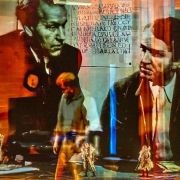
In Siegfried, the third part of Wagner’s tetralogy at the Bayreuth Festival, the AI is once again merrily spinning its web of nonsense. Just as in a Rorschach test, one tries to make sense of the abstract images. However, the ever-increasing historical references are mostly recognisable: Hitler at the Trocadéro in front of the Eiffel Tower (alongside Albert Speer and Arno Breker) after France signed the armistice; the famous photograph of the Big Three at the Potsdam Conference; the RAF logo; Willy Brandt; the Wagner brothers Wolfgang and Wieland; the entrance gate to Auschwitz-Birkenau; the dock at the Nuremberg Trials; and all manner of visual references to Frank Castorf’s Ring, to the point where it almost amounts to plagiarism. Of course, such associations can be made, but that is far from enough to convey a message.

Historic productions of The Ring at Bayreuth have always addressed the major issues of their time, whether it be Chéreau’s ‘Centenary Ring’, which explores capitalist power structures and industrialisation, or Harry Kupfer’s, which highlights the nuclear threat and the world’s increasing technologicalisation. Even Castorf’s Ring – which remains a divisive staging to this day, vividly depicting a world caught between (post-)communism and capitalism – has secured its place among the pantheon of Bayreuth productions thanks to its unique visual interpretation.
But what is curator Marcus Lobbes trying to tell us with this Ring? That we live in an age where everyone thinks they can be an artist? That there can no longer be any truly original ideas? That AI is the solution to all our problems?
What this Ring does reveal, however, is the growing anger and concern surrounding AI. The desire for genuine authenticity, for opera created by people for people – in short, genuine art rather than a simulation – is arguably the most significant insight offered by this anniversary production.
In stark contrast, performing live and without any AI frills, Christian Thielemann and the Festival Orchestra were once again on superb form. With subtle finesse, they teased out the finest details from the score, using leitmotifs as genuine narrative devices and thus telling a gripping story from the pit rather than that being told on stage.

Klaus Florian Vogt is not to be missed, performing the major tenor roles on all four evenings. Having already sung Loge and Siegmund, he now assumed the mantle of Siegfried, thereby cementing his status as one of the most important Wagnerian tenors of our time – he seems to have found his raison d’être. Vocally, this role suits him the best. With his usual bright timbre, slightly darkened, and an exceptionally agile, flexible voice, all seemed to flow effortlessly from him.
With her radiant soprano, Camilla Nylund was also wonderfully lyrical and warm as Brünnhilde. Her singing was refined, controlled and confident in the high notes, and her rendition of “Ewig war ich, ewig bin ich” sent shivers down your spine!
Victoria Randem had an engaging voice as the Woodbird, though her pronunciation was somewhat unclear. Christa Mayer, with her wide vocal range and powerful yet elegant voice, was well worth listening to as Erda.
It is with a heavy heart that we must accept that Michael Volle, having been one of the finest musical interpreters of this Ring cycle, now sings his final role with this Siegfried. As the Wanderer, he performed with a philosophical, almost serene composure. In Act 1, he portrayed his exchanges with Mime in an authoritative, striking manner. His soulful, captivating interpretation was particularly compelling during the emotional passages.

Gerhard Siegel (Mime) and Jochen Schmeckenbecher (Alberich) both proved themselves as accomplished performers. With their vocal presence and intensity, they rounded off a cast that can already be considered the ideal line-up. Even if the production may soon be forgotten – not least because this AI-generated Ring is only being staged this year to mark the 150th anniversary of the festival – one will have to wait a long time and search very hard to hear another Siegfried of such exceptional musical quality.
Translated from German by Mark Pullinger