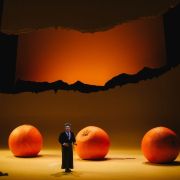
A disheartened kingdom, a depressive prince, a purposeful jester, calculating conspirators, manipulative magicians, a bizarre curse, a fiercely territorial cook, thirsty princesses trapped in giant oranges, a few avoidable deaths, an astonishing transformation, an on-off wedding, a profusion of twists and turns set to freewheeling music, and a chorus that likes to comment on the action: these are the ingredients of L’Amour des trois oranges (The Love for Three Oranges), the heady theatrical cocktail that opened the season at the Opéra de Lyon.

First performed, in French, in Chicago in 1921, Prokofiev’s extravaganza poses a challenge to any opera company when it comes to aligning the different strands of the plot – such as it is – and to managing the rapid changes of scene and set, the profusion of comic ironies, and the punctuating (and punchy) musical interludes. Some 21 years after his first production of the piece, at Dutch National Opera in Amsterdam, Laurent Pelly has returned to L’Amour des trois oranges with a new production that holds all the aces.
The unobtrusive stage décor, which makes resourceful use of dividers and lighting, can shift in record time from the hellish habitat of the vile Fata Morgana to the lair of the monstrous Cook, and Pelly choreographs the blocking and gestures of the singers with monumental precision. Nothing is left to chance – from the piquant chorus of Doctors to the numerous chase sequences, from the languid gait of Leandro, the treacherous prime minister, to the nodding and shaking of heads as the King consults his adviser Pantalon. Everything is guided by Prokofiev’s bustling score.

The costumes and props offer an imaginative complement to the sets and pacy action: the subjects of the King of Clubs, who are straight out of a game of cards, cause instant amusement; the ferocious Cook, with her mighty ladle, is more formidable than a Wagnerian dragon; the scene with the oranges is a delight, and in the concluding scene Princess Ninetta’s wedding dress is, so to speak, the candied peel on the cake. To say more would require a spoiler alert.
On the afternoon of the production’s first performance the singers still seemed to be settling into their roles; there were some minor mishaps here and there, but everything boded well for the rest of the run. After the interval the cast was fully in command of its material. Exemplifying this evolution was Linard Vrielinck in the role of the Prince: his bursts of laughter in Act 2 went musically awry, but by the time he reached his love song in Act 3 his singing was a model of tender elegance.

Damien Pass (Leandro and Farfarello) and Robert Lewis (Truffaldino) were sure bets throughout, but making the strongest mark in the large ensemble were singers in some of the smaller roles: Marc Mauillon, his diction as immaculate as his stagecraft, was the faithful counsellor incarnate as Pantalone; Giulia Scopelliti, with her luscious tone, fleshed out Princesse Ninetta to ideal effect, and Jean-Fernand Setti’s voice and presence as the (female) Cook defied all resistance.
By contrast, the opposing forces of the magician Chelio and the witch Fata Morgana proved less compelling: Daniel Mirosław was more notable for volume than for precision, especially of pitch, while Gabrielle Philiponet’s vocal power sometimes seemed to falter. As the King of Clubs, Piotr Micinski lacked majesty in his initial interventions, but gained in dignity after the interval.

There can be nothing but praise for the chorus of the Opéra de Lyon, whose members – in keeping with the demands of this work – were kept very busy; not only did they run around the stage at top speed, they timed their many lines perfectly and sang with admirable clarity. The orchestra gave an exemplary performance, extracting all the juice from the demanding score under the direction of Dmitry Matvienko, whose precise, communicative and commanding gestures were visible above the edge of the pit. A few tickets remain for further performances in the run. Squeeze one in if you can.
Translated from the French by Yehuda Shapiro.
Tristan’s travel expenses were covered by the Opéra national de Lyon and the Auditorium-Orchestre national de Lyon.