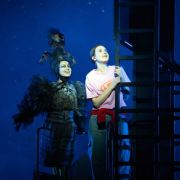
Magic things happen up chimneys, as centuries of folklore, generations of children’s literature and one F. Christmas in particular will bear out. This simple premise is at the centre of Spark, Glyndebourne’s latest youth opera commission by Lucy Armstrong and Olivia Bell.

Sad and anxious, Clara doesn’t want to go to school. Ignoring the pleading of her parents and best friend, she is visited (and you know how) by a friendly spark monster, who persuades her to venture up the chimney. There, Clara discovers a consoling, colourful world that – with its close relationship to fire – is there to help reignite her lost spark. Meanwhile, down below, Clara’s parents worry that they are losing each other in the wake of the death of their son, Jamie. And so Clara’s sadness is named. The soot monsters give Clara an ultimatum: will she stay forever up the chimney, or will she return to her parents? We all know which she’ll choose in the end but that doesn’t stop her introducing her friend Frankie to this fantasy world before she comes back down to earth, spark rekindled, ready to live with her loss and reconcile with her parents.
The first thing to say is that the 64-strong chorus, ranging in age from 9 to 19, are – to a monster – outstanding. The quality and professionalism of these dedicated young performers continues to make the Youth Opera a jewel in Glyndebourne’s crown and if I were a parent or grandparent of any one of them I would have come away, quite rightly, bursting with pride.

But a new opera commission ought to be more than an end-of-term show. A YA Mary Poppins might have looked appealing as a pitch (let’s face it, we’ve all seen enough youth operas about climate doom) and it certainly looks charming in Ryan Dawson Laight’s chim-chimeney world of brushes, dusters, grubby high-vis (health and safety), boggle-eyes and ignition-adjacent hair-dos.
However, the attempt to cater to such a wide age range at the same time as not scaring off any first-timers has created this piece’s biggest problem: focus. Although there is some lovely writing in both score and libretto, both suffer from a referential approach that prevents either really exploring the full emotional range of the story. The teenager who is grieving their dead sibling is a very different narrative prospect to the child entering a world of enchantment and there’s a sense that once Clara goes up the chimney, the opera doesn’t know what to do with her there.
Armstrong creates a spare, dark sound world for a family in crisis though enchantment is there from the beginning in the opening bars of twinkly glockenspiel, shimmering strings and a plaintive ‘once upon a time’ oboe melody. Escape up the chimney proceeds very much as one would expect, busy on the harp, plenty of swirling crescendo and boisterous chorus. As is obligatory in any British adventure to the unknown, there is a big number about tea-time, a fairground-style waltz that itemises the local menu. Crackle crumpets anyone?

Olivia Bell’s text serves up occasional tasty morsels and one truly heartbreaking observation on familial loss, “One less whirlwind to clear away.” Librettist and composer create a rare moment of alchemy as Ella Taylor’s Blaze sings “I am the shimmer on the edge of flame.” Taylor’s burnished tone has the lustre of danger that brings the two parts of the story together and gives a sense of what the piece might be if ideas like this were sustained past their initial flicker. Less successful is “Be careful what you wish for”, familiar enough as an idea from children’s adventure stories, but it’s not clear how it fits into this one specifically.
Clementine Thompson is brilliantly cast as the teenaged Clara, to whom she lent a vulnerable quality while at the same time surprising possibly even herself with the power of her lower register. Natasha Oldbury was a sweet and beguiling Ash, Clara’s gateway monster. Holly Brown was able to make a better job vocally of Mum than Flicker, though the latter was a role that gave her more to do physically, as Armstrong’s spiky high-pitched writing made diction a challenge. Hugo Herman-Wilson’s Dad/Ember was tender and engaging, while Rachel Howe supplied some excellent BF energy in Frankie.

Formerly Chorus Master for Glyndebourne’s community opera, Ashley Beauchamp knows a thing or two about safeguarding combustible materials and did an excellent job to muster the considerable forces on stage and in the pit.
Whether Spark stays alight beyond Glyndebourne remains to be seen. But plenty will have gone home with a warm glow.