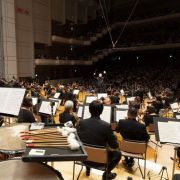
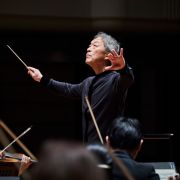
A faint pulsing sound like a heartbeat can be heard in the New National Theatre Tokyo’s auditorium, raising expectations even before the arrival of Artistic Director, Kazushi Ono, into the pit. Through a sheer curtain, the crouching figure of Elektra is visible. She slowly stands and walks towards the back wall. Just as Richard Strauss’ music begins, part of this wall falls into the shape of a giant figure – Agamemnon – leaving a gaping hole as if symbolising the void in Elektra’s heart. Maids of the House of Agamemnon poke through the hole to watch his distraught daughter.

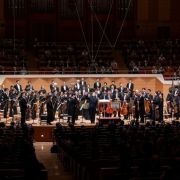
This dramatic opening set just the right tension for the NNTT’s new production of Elektra. Premiered in Dresden in 1909, Strauss’ one-act opera is based on Hugo von Hofmannsthal’s adaptation of Sophocles’ Greek tragedy, a collaboration that marked the beginning of a fruitful creative partnership between composer and librettist. Ono successfully maintained the tension through the opera’s hour and 45 minutes. The Tokyo Philharmonic Orchestra coped well in presenting arguably the most powerful and bombastic orchestral sounds of all Strauss’ operas. The almost Wagnerian development toward the end was wonderfully executed.


This is the first time that Johannes Erath has directed a production here although he and Ono collaborated on Arnulf Herrmann’s Der Mieter at Oper Frankfurt in 2017. Erath skillfully unites music and drama with Agamemnon as the pivot of the story. Although the Greek general never appears, his presence lingers in his house, and so does the curse and further evils he brought there.

The three women in the story – Klytaemnestra, Agamemnon’s widow who killed him, and their two daughters, Elektra and Chrysothemis – all suffer from different insecurities. In Scene 3, they gather in a room scattered with girlish, dreamlike furnishings, such as swings and teddy bears. Klytaemnestra, who does not usually appear in this scene, looks sick and aged here. Except for the shadow of Agamemnon looming over them, the place is devoid of any visibly masculine presence. Even the male servants and Oreste’s tutor, all fixtures in the room, are dressed like puppet clowns.
Scene changes are efficient, with minimum movement. For example, when Klytaemnestra demands to be alone with Elektra in Scene 4, the audience does not see the maids and servants exit. Instead, the curtain quietly comes down to leave only mother and daughter on stage.

The efficiency was aided by Heike Scheele’ solid set design, while Noëlle Blancpain’s costumes enhance the mythical and fantastical atmosphere. Olaf Freese’s accomplished lighting and Bibi Abel’s adept (and never intrusive) video designs complete the creative team.
Elektra requires three A-list divas whose voices will not be drowned by Strauss’ rich orchestral textures. The NNTT has been fortunate to secure a strong trio. Estonian soprano Aile Asszonyi made an impressive house debut singing the title role. Her voice is not just powerful, producing mellow sweetness when Elektra longs for her dead father in her Scene 2 monologue, adding purity to her character.


Mihoko Fujimura is one of those elite singers whose voice carries effortlessly even when she is singing softly with her back to the audience. She can also sound menacing, which makes her a perfect Klytaemnestra. Opera fans in Tokyo can count themselves fortunate that they could hear Fujimura take on the same role twice in two years, as she sang in a concert performance conducted by Sebastian Weigle in 2024. This time Klytaemnestra dons a wig when she sees Aegisth. With the silky, long-length wig, Fujimura possibly reminded many Japanese audience members of the late fashion icon, Sayako Yamaguchi.
The sheer brightness of Hedvig Haugerud’s voice suited Chrysothemis well, even if she sounded a little pressed on accurate top notes at times. The Norwegian soprano is another NNTT debutante and Tokyo operagoers can look very much forward to her Salome at the theatre next season.

Having enthralled NNTT audiences as the four villains Les contes d'Hoffmann and as Kurwenal in Tristan und Isolde in recent years, Egils Siliņš returned as Elektra’s brother Oreste, looking and sounding heroic with his robust baritone. Kazuma Kudo finely portrayed the lesser villain Aegisth with a clear and resonant tenor.
Smaller roles were appropriately executed. The brief exchange between the Young and Old Servants, deftly sung by Shuhei Itoga and Teppei Kono, respectively, added much-craved comic relief to the production. The role of the New National Theatre Chorus is limited in this opera but they did not disappoint, helping to bring the 2025-26 season to a strong conclusion.