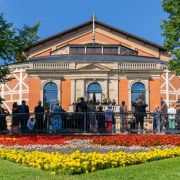
“Imagine you’ve been hired by the Bayreuth Festival as a curator and concept developer. A new production of The Ring is to be staged for the festival’s 150th anniversary. Create a concept for all four parts that draws on the festival’s history.” That, or something similar, is the likely AI prompt which served as the basis behind the concept for this year’s new production of Richard Wagner’s Der Ring des Nibelungen.

While many people’s hopes for a concert version of the cycle were well-founded given productions of recent years, a glance at the cast list revealed that this would not be possible. The title ‘Digital and AI Storytelling’ particularly caught people’s attention. Following the Parsifal staging involving AR glasses a few years ago – which many described as a failure (and which will no longer exist after 2026) – Bayreuth is venturing, entirely in keeping with Wagner’s motto “Children create something new”, into one of the hot topics currently on everyone’s lips and which polarises opinion like almost no other: Artificial Intelligence.

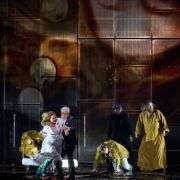
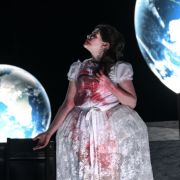
The ‘artistic’ team led by Marcus Lobbe – which deliberately avoids the term ‘direction’ – comprises roles that are still a novelty in the world of opera. Instead of a fully developed production, there is merely a concept – AI continuously generates new visual worlds which, however, do not so much illustrate the narrative as are intended, for the most part, to create random associations. One recognises a sketch of Bayreuth’s history, past productions of The Ring, historical figures such as Ludwig II, but also a great deal of generalised imagery – such as ‘lost places’, striking landscapes and industrial sites – intended to stimulate the audience’s thinking, but which is likely to provoke only bewilderment and puzzlement. The audience is left to their own devices amid distorted faces, figures with an unnatural number of fingers, vague shapes and associative puzzle pieces.


Each performance should be visually unique, but AI remains, ultimately, just AI and cannot replace human artistic ingenuity and true creativity – even if some people claim otherwise. It is precisely this soulless ‘art’ that quickly leads to disillusionment and boredom on stage.

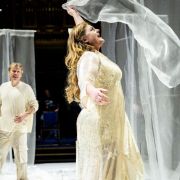
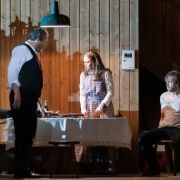
The singers, trapped between two large gauze curtains in costumes that are difficult to interpret, also betray their own sense of bewilderment. A little more Personenregie would certainly not have gone amiss, the cast mostly standing around impassively, attempting a few theatrical gestures to illustrate the action, but they end up looking ridiculous.
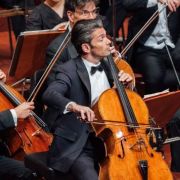
The only performers who generated any excitement were Christian Thielemann and the Bayreuth Festival Orchestra. Thielemann, whose status in Bayreuth is already safely cemented and whose performances consistently set the benchmark, also thrilled the audience with gripping conducting of Das Rheingold. During the prelude, the strings flowed along, the orchestral waves swelling and gliding musically, thus illustrating the action better than any AI ever could achieve.
Thielemann delivered an incredibly elegant yet authentic performance. With a transparent orchestral sound, he frequently adjusted tempi, though never haphazardly. It all felt spontaneous but, at the same time, thoroughly thought through. The result was a refreshing interpretation that held the production together and already had the audience looking forward to the evenings to come.

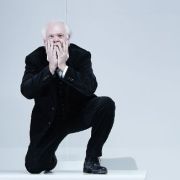
The singers were also a delight. Foremost among them was Michael Volle as Wotan, a god among the singing gods. One of the most incisive, striking and distinguished voices of his time, an established Wotan second to none, he combined an understanding of the text with authority, thereby creating a nuanced characterisation. Such a voice and stage presence are virtually unrivalled.
By his side as Fricka, Anna Kissjudit captivated with an unusually rich, fiery and dramatic voice, whose power was both compelling and fascinating. Alberich, sung by experienced Wagnerian Jochen Schmeckenbecher, drew upon the darkest depths of his baritone. His distinctive timbre and intense delivery lent his character the necessary depth.
Heldentenor Klaus Florian Vogt, a performer who is always a welcome sight at Bayreuth, achieves true all-rounder status in this Ring, securing all the major tenor roles in this cycle by making his debut as Loge. To be fair, one must say that he is ‘trying his hand’ at being a character tenor for, sadly, one sorely missed any sense of character here. There was no nuanced delivery of the text, no sarcastic wit, nor any of the biting edge inherent in the role. Instead, with little artistry and surprisingly poor diction, he practically skimmed over the text. Loge’s critical, cynical nature was completely lost in the process.


Gerhard Siegel was a characterful Mime, Alexander Grassauer an eloquent Donner and a trio of superbly cast Rhinemaidens rounded off an ensemble to a high festival standard.
As the digitalisation of public spaces continues to advance, theatres, opera houses and concert halls have the potential to foster genuine authenticity and real connections with the audience to become a place of refuge. With AI – the full extent and consequences of which have not yet been fully explored – this delicate bond is severed. What remains is an audience that is disappointed and rightly angry at being taken for fools.
Even if the production itself does not stand the test of time, Thielemann has at least laid the foundations, with this Rheingold, for an utterly memorable musical Ring performance to mark Bayreuth’s 150th anniversary.
Translated from German by Mark Pullinger