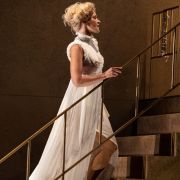


An evening at the opera doesn’t have to mean being strapped into a seat and given a lecture about the wickedness of the past or the ghastliness of modern life, as evidenced by two excellent productions led by Christopher Luscombe on the stage and Michael Roswell in the pit of the Britten Theatre. Luscombe stages Debussy’s Prix de Rome winner of 1884, L’Enfant prodigue, and Ravel’s masterpiece from 1925, L’Enfant et les sortilèges, in a manner that allows his large cast to show off their talents to best advantage. In that, he has the terrific support of Jonathan Fensom’s evocative designs, the wonderfully imaginative lighting of Mark Jonathan, and Nicola Keen’s joyous choreography. The Royal College of Music Opera Orchestra was in fine form, never getting in the way of the singers or the action but flooding the auditorium with Gallic sensuousness. Such a pairing of dissimilar works might be likened to a cinematographic double-bill of old, only here both pieces are shown to be of their own worth.


L’Enfant prodigue is a scène lyrique or cantata in one act to a text by Édouard Guinand. The narrative, about a country boy who blows his inheritance in the fleshpots of the city and returns home in disgrace, is not quite the full story as it appears in St Luke’s Gospel. However, it retains the original moral imperatives of acceptance, forgiveness and redemption. Luscombe sets it in Provence, contemporaneous with the time of the work’s composition, where it is presented as a simple – but not simplistic – opening out of the drama. The action takes place in a small community secure in its Christianity, signified by the imposing presence of a priest, yet still connected to its pagan inheritance, symbolised by the enactment of a ritual illustrative of fertility and the harvest.

In terms of the vocal performances the three characters were well-matched, perhaps reflective of the familial connections. Lia, the mother was sung with tenderness by soprano Bella Marslen; her dramatic enunciation of the famous aria bore the stamp of end-of-tether despair. As her husband, Siméon, baritone Zhen Liu overlaid the leaden grief with a patina that will shine more brightly in bigger roles. Tenor Edvard Adde gave the errant son Azaël a suitably humble entreaty for letting bygones be bygones, in both the mother-son and father-son encounters. The closing scene with the family reunited, reintegrated into the community, sent out a glorious stream of light in praise of the Almighty.
Soon after the spell began its work in L’Enfant et les sortilèges it occurred to me that I hadn’t seen any trigger warnings about the production not being suitable for young children, despite being set in a nursery! Luscombe, to use a well-worn but eternally serviceable phrase, pulled out all the stops to serve up a highly entertaining enactment of the magical concoction. The entire cast rose to the occasion, setting aside all of the ‘ologies’ with which the work is often freighted to offer up a thoroughly theatrical experience full of memorable moments redolent of the 1920s.


There is not enough space to credit all of those moments but the sample I have chosen are spotlights on the wallpaper in the nursery. The Teapot of Francis Melville and the Teacup of Kate Reilly were a great double act, vaudeville stars in the making. As Fire, Ariana Ricci was a fabulous chanteuse, her seductive grace headlining the floorshow. As Grandfather Clock, Oliver Barker could give Einstein a lesson on the fact that time does what he likes, when it pleases him.

Taining Zhao’s Schoolteacher, class in train, was absolutely convincing as the ideal means for your children to learn their numbers. Mezzo-sopranos Angelina Dorlin-Barlow and Lauren Bagge played the recalcitrant Child and the despairing Mother with assurance and intelligence. The former clearly remembered what it was like to be that age and the latter, although not a large role, is embodied in the last notes of the score – the uttering of “Maman” perhaps a thumbed nose to the ‘ologists’. What was clear is that the RCM Opera Studio can put on a high-quality show that entertains and enthrals.