A dubious nobleman, concealed identities and lovers restored to harmony. It could be any one of Mozart’s mature operas, but it is in fact La finta giardiniera, a work written at the tender age of just eighteen. The youthful energy of this early opera, combined with its innately farcical nature, makes it a natural fit for young singers, and the Royal College of Music’s decision to choose it as its spring production was a deft bit of programming.

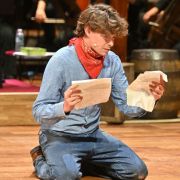
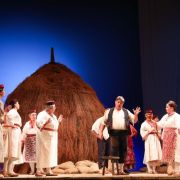
Stephen Barlow’s production is a cheerfully chaotic affair that blends a range of costumes, from period to modern, with modern utilities such as leaf blowers and hoovers. Singers step forward to bid the orchestra to excise unwanted numbers from what is a fairly expansive score – at one point, shears are used to make literal cuts – and the complicated dramatis personae is covered by a perky introduction as the overture plays. Designer Yannis Thavoris provides a bright, but uncluttered set, relying on a little furniture and a statement floral background which changes as the day unfurls. Barlow doesn’t dig too deep into the characters; a policewoman turning up at the end to deal with Belfiore is the only hint that there’s more in his past than nearly murdering one of the main characters (with whom he ends up happily ever after). The production is not able to deal with that discordant note to the opera’s comedy, but it’s a difficult problem to resolve and Barlow very much focuses on keeping the comedy bubbling.


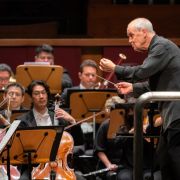
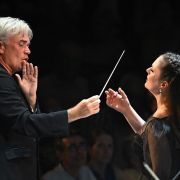
Student ensembles can occasionally sound a little rough, but on first night the RCM Opera Orchestra very nearly stole the show under Michael Rosewell’s baton. Some slightly tricky moments for brass aside, the playing blended daintiness with momentum that kept the evening zinging along, and sounded delightful on the ear. The RCM had assembled a strong cast of principals. For stage presence, Edvard Adde takes the laurels as a faintly absurd Don Anchise, less a senex amator, more one of those fellows whom we all know: unlucky in love and yet struggling valiantly in its pursuit. Adde’s exuberance occasionally took him away from song and into declamation, but it was fine and robust performance. Ramiro, a trouser role, was sung by Cecilia Yufan Zhang, who displayed a mezzo with nice shading, but whose runs occasionally were a little imprecise.

Charlotte Jane Kennedy gave us a moving “Sandrina”, the fake gardener of the title, with plenty of heft to the high notes, while Eve Pearson Maxwell’s Arminda sizzled – hers is not the largest voice, but she showed fine technique and deft precision in her delivery, while stomping about in the finest traditions of bratty youth. Eden Shifroni showed an excellent line in the side eye; never has a cake stand seemed so menacing as in the hands of her Serpetta. Another smaller voice, but with plenty of character to it. As Belfiore, Francis Melville gave us more of a duffer than a rat; his is an elegant tenor, but needed a little of an edge on his phrasing to make the most of the character. Zhen Liu completed the cast, showing a smooth baritone as he desperately lusted after Serpetta.


Student productions offer not just a chance to hear some unusual repertoire, but also a health check on our next generation of musicians. On the strength of this performance, the prognosis is distinctly positive.