

Sydney’s Pinchgut Opera marks its 25th year with a new production of Handel’s Semele, the first work it performed in 2002, in the same place, the City Recital Hall. Pinchgut perseveres in presenting staged operatic performances in challenging venues – no proscenium arch, no fly tower, no orchestra pit – and often of repertoire not intended to be staged. They carry them off with musical brilliance and dramatic flair.

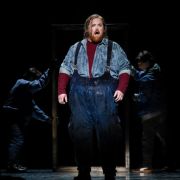
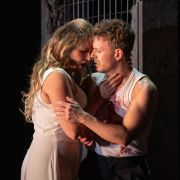
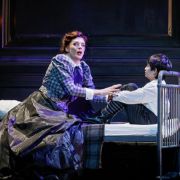
The stage was divided in two, with the orchestra on the left side and the action on the right. This did not provide much space, but the action was deployed throughout the theatre, with the choruses often sung from the galleries and the soloists appearing at different locations. Iris arrives in a flurry of lateness, running up to the back of the auditorium and down again, gulping from her water bottle while Juno taps her feet. Semele, not surprisingly, sings “Endless Pleasure” from the organ loft. Renata Beslik’s costumes were modern, Semele appearing first in a white wedding dress but spending most of the time thereafter in a pink nightie, while Somnus’s flanellette jammies contrasted with Jupiter’s black silk version. The zephyrs attended Semele dressed in white uniforms like spa attendants. Neil Armfield’s direction kept the story moving with admirable clarity.


The narrative was enhanced by a most effective video display, appearing on a vertical screen behind the right side of the stage, where Juno appeared in her glittering gold tunic, with fire in her hands arising or dying according to the text. As Cadmus describes Semele’s apotheosis, we see her ascending to the clouds as she is enfolded and carried off by a most convincing eagle. And we get to see the fierce dragons guarding the love nest.

The score was somewhat trimmed, but not so as to impede the plot. Semele’s aria “The morning lark” was omitted, but it is rather an indulgence. Ino and Athamas suffered the most in this respect, with only their Act I interaction left intact. Looking forward to the final happy ending (for us, not Semele), her pregnancy with Bacchus is indicated in her reluctance to marry Athamas.
The Orchestra of the Antipodes has been with Pinchgut since the beginning, albeit with shifting personnel, starting under the direction of Antony Walker, more latterly, as tonight, led by Erin Helyard from the harpsichord, with concertmaster Matthew Greco. The score requires relatively small forces, basically oboes, bassoons and strings, but horns are indicated for the Act I finale, and trumpets for the end of Act III; in this instance, we had horns on both occasions, ably played by Carla Blackwood and Dorée Dixon. Drum rolls also accompany appearances of deities (timpani by Mark Robinson). As usual, the performance on historical instruments was an unmitigated delight, played with commitment and finesse.

For the choruses, a small ensemble of sixteen fluctuated somewhat in size due to its inclusion of several of the soloists, probably a reflection of the original 18th century performances. They performed with admirable precision.
In the title role, Alexandra Oomens inhabited the character and sang with undiluted beauty of tone and great technique; it’s a pity the bird aria was omitted, and “Endless pleasure” seemed a little rushed. By the time we got to “Myself I shall adore”, however, her voice had reached its full glorious bloom and this was an absolute highlight in every way. While she sang – into a mobile phone – her image on the vertical screen demonstrated her radiant beauty and also a certain smug satisfaction integral to the role, while her singing was a marvel of silvery tone and precise coloratura. English tenor David Webb sang with pleasing tone, if his coloratura was somewhat less crisply articulated. His rendition of “Wher’ere you walk” sounded less smarmy than it can sometimes be and genuinely caring.


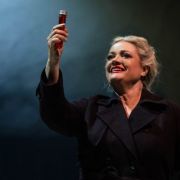
There was no doubling of roles here. Juno was sung by mezzo Catherine Carby, well known here and in London, in a particularly stern take on the role, a goddess not to be messed with. She looked formidable and delivered her part with ringing authority. Her “Beyond measure” could have been a bit more gleeful in its triumph and her cut through had fallen off a bit at this point, but otherwise, it was an impressive performance. Myriam Arbouz was a thoroughly delightful Iris, with a richer soprano than often in this part, as was Hannah Fraser’s mezzo Ino. Her Act II duet with Semele blended well and sounded lovely. Isabelle Zammit had a nice clean soprano attack on the tiny role of Cupid. Austin Haynes was a somewhat tremulous Athamas, Sebastian Maclaine a robust and cheerful Apollo, Freddy Shaw again belied his youthful appearance with a rumbling bass High Priest, Nicholas Dinopoulos was a harried but nicely modulated Cadmus, and Andrew O’Connor a sonorous and well performed Somnus.