As Melbourne awaits the return of Opera Australia, a number of smaller companies have been making contributions punching considerably above their weight – Victorian Opera, Melbourne Opera, and now BK Opera with an impressive rendering of one of the giants of the repertoire, Wagner’s Tristan und Isolde. This was not a full-on main-stage production – Northcote Town Hall Arts Centre is a far cry from the State Theatre – but was nonetheless a compelling production with singing that could have graced any opera house in the world.

Rather than an orchestra, the score was rendered by two pianos played by Shauna Beesley and Konrad Olszewski, under the direction of conductor Kelly Lovelady. While one naturally missed the shimmering experience of the original, one of the most unique soundscapes in the operatic universe, it did allow the drama to stand out in relief, and provided sufficient support for the singers. There was an extra layer of sound (courtesy Jack Burmeister), which provided an atmospheric marine and wind ambience in the first act, but just kind of rumbled on thereafter, proving something of a distraction at some moments.


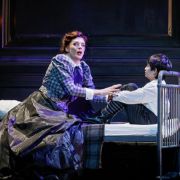
Director Kate Millett chose to emphasise the intimate nature of the story, which is its essence, but not without convincing action when needed, as in the fight scenes in Act 3. The venue is a classic Australian late 19th-century town hall, with good acoustics and a rather small stage. The performance space featured a thrust stage built out into the auditorium just a metre or so above floor level, with steps rising at the stage ending up in something like a ship’s prow (set by Ishan Vivekanantham). In its centre is a pit, within which a kind of canvas structure arose suggesting a sail. After the protagonists drink the potion, this falls away to reveal an embankment of flowers. As their affair becomes heated – very heated indeed, and one notes the need for an intimacy coordinator – misty air is sprayed around and the flowers start to wilt; when it all goes pear-shaped, they decay away. The three nurses/maids coming in to tend to the wounded Tristan and clean up the joint is a nice touch.

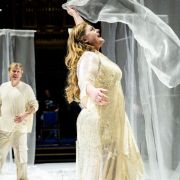
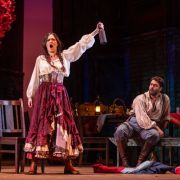
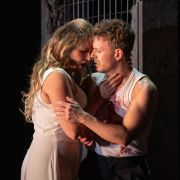
Oliver Hall’s costumes are stylised modern-ish, rather than stylised medieval-ish. Isolde, who is discovered on stage before the audience starts to filter in, initially wears a sombre overcoat affair over a longer dress and ankle boots, and Brangäne something similar, while Tristan first appears in a 20th-century military uniform. König Marke is attired in a more splendid version in white with gold-fringed epaulettes. After an interval at the end of Act 1, Isolde appears in a sunny orange-yellow paper dress adorned with flowers, similarly Brangäne in pink, then Tristan in a flower adorned dark blue vest plus cape affair. Overcome with passion, he tears Isolde’s dress off her and she continues thereafter in a black slip as things get very steamy, but which ultimately leaves her looking vulnerable and exposed.

Lee Abrahmsen is in every respect an Isolde to die for. She lays a fair claim to being the Australian Wagnerian soprano de jour, with a powerful, gleaming golden yet warm voice, even and accurate, apparently effortless, with no sign of flagging throughout. Her Liebestod was everything one could wish for, starting gently, building to glorious waves of sound, beautifully phrased, totally mesmerising. Her acting was equally convincing, reflecting every emotion inherent in the part, from royal outrage, to consuming passion, regret and final acceptance. She was well partnered with James Egglestone as Tristan, a well known and versatile Australian tenor. He was equally convincing vocally and dramatically, every inch the heroic knight, the ardent lover and the guilty betrayer as required, singing with ringing tone.


As Brangäne, up and coming singer Belinda Dalton, billed as a soprano but with a mezzo-ish timbre, made a strong impression. Her voice had power to spare coming from her slight frame, and she made the most of a somewhat thankless role (chief nag and cup bearer). Before the show started, an announcement was made to the effect that Warwick Fyfe, as Marke, was unwell but would carry on, craving our patience. It was hardly necessary. Fyfe, recently seen as everything from Wotan to Frank the gaoler in Die Fledermaus, sang with absolute security of tone and his usual bass sonority, with just one or two tiny coughs aside. His was also a dignified, more in sorrow portrayal. All the lesser roles were well filled. Melot was sung with nice bronze tone by Daniel Szesiong Todd, Henry Shaw was a resolute Kurwenal and James Penn as the Steersman had a rather rough-hewn but powerful tenor.