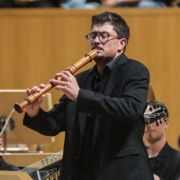
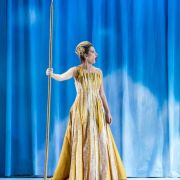
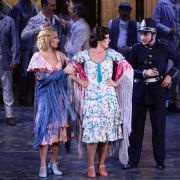
“There is nothing in life quite like the sorrow of being blind in Granada”. The words of the poet Icaza, found on a plaque in the Alhambra, are true enough. But being deaf in the Nasrid capital – deprived of the murmur of water, and the music that flows from the city’s every corner – would not be far removed from that misfortune. Architecture and music go hand in hand here with a particular intensity. For music lovers, Granada inevitably brings to mind its famous summer festival, one of the most time-honoured in Spain, also inextricably linked to the Palace of Charles V. Between June and July, every year since 1952, the Granada Festival fills its iconic venues with music, from the Alhambra to the monuments of the historic centre, dominating Granada’s cultural landscape just as the red fortress dominates the city. But musical activity is by no means confined to the festival.

Set discreetly in the background, so well-integrated into the landscape of the Alhambra hill that, despite its size, it is hard to make out, the Centro Manuel de Falla is the true musical heart of the city. This cultural complex brings together both the Manuel de Falla House-Museum in the Carmen de la Antequeruela, where the composer lived from 1922–39, and the adjacent auditorium and study centre. It also incorporates the former garden of the Carmen del Matamoros, a charming and intimate space through whose old trees one gains access to the concert hall.
The Auditorio Manuel de Falla was built to meet an important need: the Granada Festival did not have a venue sheltered from the elements. The city council was also seeking a facility that could serve the city for the rest of the year, hosting music, theatre and conferences. Working closely with Lothar Cremer (acoustic engineer at the Berlin Philharmonie), the architect José María García de Paredes – who had personal and professional ties to Falla – designed a hall that is in itself a refined musical instrument, an ideal setting for the creation and enjoyment of music.
The complex is completed by a study centre, which transforms it into a vibrant and functional building, imbued with the spirit of Falla: the humility of the materials, the simplicity of the construction and the formal perfection of the design serve as an architectural reflection of the composer, to whose music the auditorium was inaugurated on 10th June 1978. This truly privileged venue is home to the Ciudad de Granada Orchestra. Founded in 1990, its symphonic season forms the backbone of Granada’s musical life, with concerts running from September to May that attract both locals and residents from across the province. The orchestra also travels, bringing music to various towns across the province on its spring tour.


Owned by the city council, just like the Manuel de Falla Centre, the Isabel la Católica Theatre has, since its opening in 1952, hosted not only spoken-word theatre but also a wide variety of musical events. Shortly after it opened, Andrés Segovia performed there at the closing concert of the first Granada Festival. Today, for example, it hosts the Jazz Festival, which began in 1980 and has featured established national and international artists. The theatre is not reserved for professionals alone: since 2019, the annual flamenco dance showcase “Granada Baila” has assembled on its stage hundreds of young students from dance schools in Granada and the surrounding province.
The theatre’s capacity is not ideal for opera, but, in the absence of better alternatives, Juventudes Musicales de Granada has been staging opera there since 2024 as part of its season – an initiative aimed at revitalising opera and zarzuela in a city that once boasted two opera houses: the Teatro del Campillo and the former Teatro Isabel la Católica, both of which have since disappeared. In 2008, a design competition was held for an opera house, but the winning project never came to fruition, meaning that opera lovers in Granada must make do with concert versions, semi-staged productions or smaller-scale performances.

The capital’s cultural infrastructure has been steadily growing with the emergence of a number of more modest venues suitable for small and medium-sized concerts, which help to broaden the range of musical offerings. Although some are associated with specific events – such as the Auditorio Caja Rural de Granada, home to the “Tocando las Estrellas” (touching the stars) festival, which since 2019 has brought together classical music, flamenco and jazz. All of them open their doors to the various festivals and concert series held in the city, which thus sees musical performances spread throughout its breadth.
The CajaGranada Cultural Centre, designed by architect Alberto Campo Baeza, and the Federico García Lorca Centre each provide versatile and flexible black-box theatres. The Antonio Jiménez Torrecillas Hall, which opened in 2025, is located within the striking Alcázar Genil metro station, a posthumous work by the Granada-born architect after whom it is named. Moving from underground to higher ground, the La Chumbera Municipal Theatre, situated in Sacromonte, comprises two spaces: a small outdoor amphitheatre and the Enrique Morente Auditorium, whose stage is set against a huge glass wall offering spectacular views of the Alhambra.

These venues host a highly diverse musical programme, in which flamenco plays a major role. Thus, throughout the year, La Chumbera presents the “Patrimonio Flamenco” series, as well as a number of concerts from the Milnoff, a festival founded in 2020 by Pepe Luis Carmona “Habichuela”, whose full name, Mil novecientos veintidós Festival Flamenco, refers to the historic Cante Jondo Competition organised at the Alhambra in 1922 by Manuel de Falla, Ignacio Zuloaga and Federico García Lorca.
And when discussing flamenco in Granada, one simply must mention the Peña “La Platería”, the oldest of the flamenco clubs. Founded in 1949, it is regarded as the successor to the gatherings at the Taberna del Polinario, which were attended by Falla, Zuloaga and Lorca, amongst others. Throughout the year, it hosts dance, singing and guitar performances as part of its “Jueves Flamenco” series. It is also the main venue for the Antonio Marín International Guitar Festival, which, every summer since 2017, has attracted musicians and enthusiasts from all over the world to the city, with programmes ranging from Renaissance music to the very latest in flamenco.

The city’s rich historical and artistic heritage also provides a setting for concerts, both for the festivals mentioned above and others. The recently established Granada Sacred Music Festival, held in October, stages its free concerts in religious venues, ranging from the ruins of the early Christian church at the Roman Villa of Los Mondragones to the Royal Chapel, a jewel of the late Gothic period, via the Royal Monastery of San Jerónimo and the Church of Santo Domingo – both of which were begun in the Gothic style following the conquest of Granada and completed in the Renaissance style, featuring splendid Baroque altarpieces.


Meanwhile, the Granada Early Music Festival, which has taken place in the second half of May every year since 2016, is not confined to churches and convents, but also extends to numerous secular monuments. Of particular note is the enormous variety of styles and periods represented by its regular venues, ranging from the humble communal courtyard of the Corrala de Santiago to the stately Palacio del Almirante, both dating from the 16th century, and from the functional architecture of the Corral del Carbón, a 14th-century grain exchange, to the splendid gardens of the Carmen de los Mártires, a 19th-century pleasure palace.

Many of these buildings are also used by the Granada Festival, whose main activities are centred on the Alhambra and Generalife complex, with concerts in venues such as the Patio de los Arrayanes, the portico of the Palacio del Partal or the Patio de la Acequia. When the festival was founded, Granada lacked a suitable venue for dance, so the Alhambra’s conservation architect, Francisco Prieto-Moreno, designed an open-air theatre in an extension of the Generalife gardens, which was inaugurated in 1953 for the festival’s second edition. Because the style of this Teatro del Generalife – a horseshoe-shaped theatre with two rows of boxes – was not in harmony with its surroundings, it was completely refurbished between 2003 and 2005 by the architect Pablo Ibáñez, who created a rectangular design much more in keeping with the gardens in which it is set. The rows of cypress trees that frame the stage area are one of its most striking features.
But without a doubt, the festival’s most iconic venue is the circular courtyard of the Palace of Charles V, designed by the painter and architect Pedro Machuca, where the most prominent concerts of each edition take place. Interestingly, this unique venue was home to the festival’s direct predecessor: the Corpus Christi symphonic concerts, which were organised there from 1883 onwards.

Nor is the music confined to buildings. Many events take place in the city’s streets and squares, such as the popular “Plazoletas Flamencas del Milnoff” series, which brings free performances to Plaza Bib-Rambla. One of the major highlights of the Granada Festival, La Fura dels Baus’ production of Manuel de Falla’s Atlàntida, was staged in 1996 in Plaza de las Pasiegas, with the cathedral’s Baroque façade as a backdrop.
Granada’s bid to become the European Capital of Culture in 2031 has given a renewed boost to the city’s cultural life in recent years, strengthening existing events and encouraging the creation of new programmes. Thanks to the work of public and private organisations, as well as amateur and professional musicians, music is never far away at any time of year. The whole city is a stage.