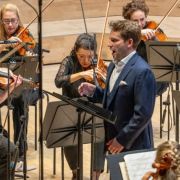

The BBC Philharmonic Orchestra has long pushed musical boundaries, and its concerts at the Royal Northern College of Music have provided an ideal venue for adventurous repertoire. In ‘British Iconoclasts’, they presented a conductorless ensemble of strings, programming British music from the Renaissance to the present day, revealing a rich variety of musical voices with Britten’s Les Illuminations and Tippett’s Fantasia Concertante among the highlights.

The first ‘iconoclast’ was William Byrd, whose Christe qui lux es et dies was arranged by leader Zoë Beyers. Written at a time when Latin motets were intended for private use, the arrangement retains the intimacy of the original while exploring the different timbres and colours of the strings. The phrasing was reminiscent of a singer shaping a line, with principal viola Steven Burnard playing a particularly prominent role in a commendable performance.
The central work of the first half was Errollyn Wallen’s Photography (2006). Its four short movements brought a riot of colour, which the Philharmonic strings seemingly relished. The first, a sort of moto perpetuo, burst with energy and vitality; the second, neo-Baroque in style and quoting Bach, was darker, with an austere ending. The third was texturally complex, more dissonant and almost monochromatic, while the fourth explored textures and timbres to great effect, playing to the ensemble’s strengths in communication and cohesion.
Tenor Guy Cutting joined the orchestra for Les illuminations. Britten’s understanding of string writing is highly evident in this work, his experience as a viola player having informed his instrumental skill. The opening fanfare was bright and joyous, with Beyers demonstrating her ability to confidently lead from the violin. Cutting’s voice was rounded and warm, with the upper reaches comfortably within his range. At times, however, he lacked a little protection, being slightly overshadowed in Villes, where his diction was also occasionally muddied. He was excellent in Marine, with crisp articulation and precise execution of its melismatic runs. The final three movements were the most successful: Being Beauteous was thoughtful and considered; Parade angular and forceful, with Cutting exploring the song’s operatic qualities; and Départ expansive and expressive. Beyers held the silence after the final notes to perfection.

Edmund Finnis’s Hymn (after Byrd) returned to the music that opened the programme, quoting the Byrd motet. Its predominantly homophonic textures, with rhythmic lengths varying between sections, created a contemplative atmosphere. Beyers brought stillness and spirituality to the work, allowing the music to dissolve into silence.
Cutting rejoined the orchestra for Tom Coult’s Black Shuck Lament (2025), combining texts from the Book of Lamentations with contemporary accounts of the legendary Black Shuck, a spectral dog associated with the 12th century. This single-movement work showed influences of Britten and Sondheim in its approach to text-setting, with echoes of Britten’s Canticles and The Turn of the Screw. Cutting moved assuredly between singing and an almost spoken delivery.
The evening’s final ‘iconoclast’ was Michael Tippett, whose Fantasia concertante on a Theme of Corelli brought the programme to a close. Beyers and two principal players formed the concertino at the centre of a semi-circle, flanked by the concerto grosso and concerto terzo groups, both using the minimum ensemble sizes specified. This did not diminish the sound: the BBCPO strings played beautifully in the slower sections and with exhilarating urgency in the more energetic passages, making the most of the music’s rich timbres and textures. It was a fitting conclusion to a programme celebrating the individuality and inventiveness of British composers past and present.