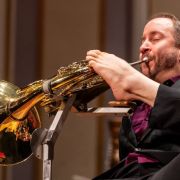
Felix Klieser is without doubt a remarkable musician, not only for the astounding way he plays the horn using his toes to control the valves (he was born without arms) but for the way he refuses to make that the most important thing about him. He is all about the music rather than the physical feats he has to achieve to perform it and, in this concert with the Royal Scottish National Orchestra, Richard Strauss’ youthful First Horn Concerto brought out the best in him, showcasing sensational legato in the solo part.

There were times when his tone wasn’t perfect – there were a fair few squashed notes and a touch of braying around the edges – but he always played with lyrical insight, balancing the dynamic energy from the orchestra, even if the RSNO could perhaps have done with a touch more Straussian swagger to match their soloist.
Alongside their delicate performance of Mozart’s Marriage of Figaro overture, the orchestra summoned up something altogether more monumental for Bruckner’s Eighth Symphony in a performance built principally on a stunningly full string sound. The sheer richness of the first movement’s first theme had a sit-up-and-notice quality even before the brass entered to do their business, and the violins positively soared through their melodies. Unsurprisingly, this culminated in the opening of the great slow movement which felt not so much like a warm bath as a cosmic immersion in sound, a study of movement and stasis miraculously combined into one.

None of this would have worked had it not been for conductor Thomas Søndergård‘s understanding of the work’s overall structure, which meant that every climax, while hard-fought, felt neither strained nor superficial. He had also figured out the tempo relations very persuasively so that the speed of the Scherzo balanced the breadth of the first movement, and that the Adagio always had a noticeable pulse to keep it moving. He couldn’t avoid a slightly soupy feel to the second movement’s Trio, nor fix the stop-start quality of the finale, but the symphony culminated in a tremendous sense of swelling majesty in its coda.
Sadly, however, I don’t think I’ve ever seen so many people walk out of a concert as in the second half of this one. It must have been more than 50 people, the walk-outs starting during the second movement and dribbling right through to the end. Of course, people leave concerts for lots of reasons, but this must have been hugely discouraging for the players, and I wonder if there’s a lesson here for the orchestra’s programming team? It’s likely that seeing Klieser would have been a draw for many first-timers rather than established aficionados: after such an accessible first half, was it really a good idea to hit them with 80 minutes of heavy-duty Bruckner in the second?