Edvard Grieg’s Peer Gynt includes some of the most recognizable melodies in all of Western classical music. Yet those familiar themes constitute only the tip of the iceberg of an ambitious work. Over the weekend, the Houston Symphony offered an hourlong slice of the piece, traversing 13 selections interspersed with dialogue by a trio of actors from Houston’s Alley Theatre — a company set to perform the complete Henrik Ibsen play in Fall 2027.

Actors Christopher Hury, Luis Quintero, and Alexandra Szeto-Joe had charismatic stage presence, delivering Ibsen’s text in an informal English translation by Paul Walsh. While the spoken interludes may have interrupted the musical flow, it allowed one to experience Grieg’s work truly as incidental music, the way it was originally envisioned. Under the direction of guest conductor Dima Slobodeniouk, the Houston Symphony breathed life into Grieg’s colorful score, and made a compelling case for hearing Peer Gynt beyond its highlight reel.
The festive At the Wedding opened to brightly set the scene. Given with abandon, it melted into a lyrical theme in the clarinet and oboe, while the viola evoked a rustic fiddle. What was most striking was the original orchestration that includes chorus, a layer excised from the suites in which this work is usually presented. Hearing In the Hall of Mountain King with the Houston Symphony Chorus was a captivating way to experience it afresh. In the Night Scene near the end, the chorus with the addition of organ made for a particularly poignant atmosphere.
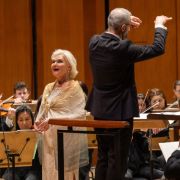
The part of Solveig is scored for soprano soloist, given this weekend by Karita Mattila – luxury casting to engage such a legendary voice for such a small part! During the orchestral introduction to Solveig’s Song, she emerged from backstage clad in white, an angelic presence. The richness and power of her voice was utterly captivating, and she was given the final word in the quietly reflective Solveig’s Cradle Song which closed the evening.
Though Russian-born, Slobodeniouk has spent most of his life in Finland and is a keen interpreter of Finnish compatriot Jean Sibelius. The first half of the program featured consecutive opus numbers from Sibelius, beginning with the tone poem Pohjola’s Daughter. A deep, dusky resonance opened, with burnished solos from the cello and bass clarinet. The conductor marshaled the brass for caustic climaxes in concentrated intensity, only to reach a somber end as it faded to silence.
Sibelius paused composition on the tone poem to write The Captive Queen which engages the chorus for text by Finnish poet Paavo Cajander. It’s a piece with a nationalist bent, owing to this fractious time in Finnish history. It’s written in a rather more populist style than Pohjola’s Daughter, and nowadays is mostly a historical curiosity. Nonetheless, it proved an appealing listen. Pulsing strings began before the chorus entered, declarative, direct, and quite an imposing force. A section for the women of the chorus was gentler, decorated by silvery flutes, ahead of the work’s invigorating close.
Situated between the two Sibelius pieces was William Grant Still’s Threnody (In Memory of Jean Sibelius). Written eight years after the elder composer’s death, the Finn is recalled by the vigorous brass and sweeping, tragic melody. A snare evoked a chilling funeral march, replete with tolling bells. Though a brief work, it made a powerful statement, an affecting tribute from one composer to another.