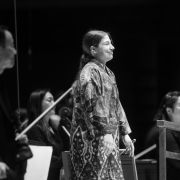
If the program helmed by Dalia Stasevska at the Philadelphia Orchestra this past weekend had a theme, it could properly be described as ‘buried treasures’. Making her third local appearance inside of a year, the Ukrainian-Finnish conductor returned Respighi’s Pini di Roma to the repertoire for the first time since 2018, and conducted the first performances of Saint-Saëns’ Third Violin Concerto since 2012. Drawing on her national heritage (and marital family ties), she brought back the Sibelius tone poem Pohjola’s Daughter after a 24-year absence. Anna Meredith’s Nautilus – originally written as electronica, with an orchestration later commissioned by Stasevska – had its first hearing at the start of the concert.

Did this unusually generous offering spark the thrill of rediscovery? Largely, yes. Stasevska’s ebullient personality and knack for harnessing this orchestra’s most extreme sonorities certainly suited the Respighi well. Yet even amid the dizzying swirl of The Pine Trees of the Villa Borghese, Stasevska highlighted radiant individual voices within the whole: the mellow glow of the English horn, the shiny tinkle of the celesta. There were some missteps – the decision to place the offstage brass in a second-tier stage box washed out the power of the organ – and the performance sometimes lacked a natural sense of progression across the four continuous movements. But Stasevska mostly kept the shock and awe from descending into schlock and awe.
By contrast, Pohjola’s Daughter emerged as the last word in narrative cohesion, beginning with the richly voiced cello solo performed by Principal Hai-Ye Ni. Stasevska drew arresting weight from the woodwinds and subtle, perfectly tuned contributions from the brass. The orchestra moved effortlessly from full-throated cries to mournful whispers, representing the full portrait of the composer’s musical arsenal. Whether or not a listener was familiar with the programmatic story often assigned to the work – which involves the mystical Väinämöinen’s infatuation with the beautiful title character – they could easily ascertain a story rife with obsession, love and loss from the passionate playing.
Philadelphia favorite Gil Shaham joined Stasevska for the Saint-Saëns, but this performance of a work he knows well felt oddly subdued. His refined style and light tone best suited the central Andantino, where Stasevska also kept the orchestral forces at bay to best highlight her soloist’s soft playing. But Shaham lacked forwardness in the outer movements, leading to a tendency to be covered in forte passages. Shaham’s stage presence on this evening also seemed strangely coiled: often standing inward and in profile, he kept his eyes firmly trained on Stasevska, barely acknowledging the audience until the work’s conclusion.
Nautilus presented itself as the kind of work that immediately demands a second hearing. You simply cannot believe how many ideas Meredith squeezes into its six-minute running time. (Jack Ross did the orchestration, based on Meredith’s original.) What begins as a fanfare quickly descends into a funhouse mirror of distortion, metric irregularity and levels of intentional ugliness that could make Berlioz blush. At the composer’s insistence, Stasevska and some of the musicians used a click track, which heightened the sense of musical tension with the other sections who were instructed to play freely. Meredith’s experiment mirrored nicely with the chaos that came later in Respighi, though the younger composer denied her audience the sense of cathartic release.