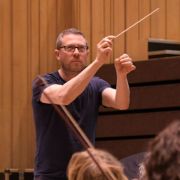
The summer slots often throw up some special treats as orchestral seasons enter their final phase, and this concert brought two high profile guests to the Royal Scottish National Orchestra: not just regular collaborator John Wilson as conductor, but a less frequent visitor in pianist Sir Stephen Hough. Put them together and there’s bound to be magic, and it must have been pretty close to wizardry that they almost managed to argue a convincing case that Rachmaninov’s First Piano Concerto is an equal to the composer’s other three.

It isn’t, but even I was (briefly) persuaded by the way Hough tackled the arresting opening stride down the keyboard, answering the sweeping strings with conversational personability, and taking us on an unusually jocular trot through the composer’s first movement. Hough’s playing was astonishingly controlled. Torrents of chords tumbled from his keyboard, yet he barely seemed to move a muscle, losing himself completely in the craft of what he was producing. The rhapsodic second movement couldn’t avoid sounding piecemeal, but that’s Rachmaninov’s fault rather than Hough’s, and if the finale was unduly flashy then you’ll never hear flash that sparkles with so much class.
Wilson shaped the orchestral part with as much upbeat optimism as Hough found in the keyboard part, the strings full of sunlight rather than Slavonic darkness, seemingly finding Sheherazade like levels of exotic allure in the slow movement. He exerted similar, vice-like discipline over the opening phrases of Ravel’s La Valse, with every beat, every nuance, every dynamic expertly shaped and shaded. That made the ultimate collapse all the more compelling, like watching a slow-motion car crash happening before your eyes. It appeared all the more tragic because those initial waves of melody were so heartbreakingly beautiful, with decadent swoops of violin tone in the ravishing waltz melodies, and sweeping harp glissandi that felt like pulling back the curtain on another world.

Darkness ultimately overtook everything, however, and in that La Valse had something in common with Wilson’s take on Vaughan Williams’ A London Symphony. That wasn’t only in the way both pieces began by creeping slowly out of the primordial gloom, theatrically gripping as that was in the symphony. More than that, Wilson painted the symphony as being tinged with gloom and its fair share of tragedy. Sure, there were moments of bombastic celebration, not least the conclusion of the first movement with its burst of sunlit brass, but more than ever this felt like a melancholic reflection on humanity rather than a musical tour of London. The outburst that began the first movement’s Allegro section, for example, felt uncomfortably close to a shout of pain, and the slow march of the finale seemed to speak of something majestically intimidating rather than uplifting. Moreover, the way Wilson held on tight to every note of the final fade-out, eking it out in a way that seemed reluctant to let it go, felt elegiac and wounded. If this music really is a meditation on England’s passing, then here it cut straight to the heart.