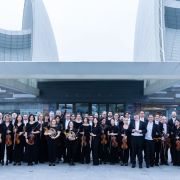

It has only taken just over a hundred years since it foundation for the Stuttgart Philharmonic to arrive at Sheffield’s City Hall, but the very enthusiastic response of the larger than usual audience suggests that they would be welcome back in rather shorter order. In an evening of musical favourites, Mendelssohn’s Hebrides Overture is a piece many orchestras could probably play in their sleep, but the Stuttgart players and their stylish Argentine-Italian conductor Mariano Chiacchiarini made us listen afresh by focusing on warm and mellifluous woodwind playing, notably some wonderful clarinet solos, and a string sound that was precise in rhythmic attack and with carefully graded dynamics. If the sea didn’t seem especially rough on this particular trip to Staffa, a voyage recollected in tranquillity perhaps, the picture-painting experience showed Mendelssohn’s often underrated role in the evolution of the symphonic poem.

Standing in for the indisposed Jeneba Kanneh-Mason, Leeds International Piano Competition winner Alim Beisembayev offered a reading of Mozart’s turbulent Piano Concerto no. 20 in D minor of exemplary clarity and elegance. This is operatic Mozart, and Beisembayev ensured that we could hear the piano’s vocal lines with little recourse to histrionics or emotional manipulation. Even the febrile central episode of the second movement Romanze retained a fundamental coolness, so that the music’s classical poise was never overwhelmed by the storms and stresses of any kind of Beethovenian angst. Not everything worked: Beisembayev was given to occasional flurries of ornamentation, a kind of Rococo elegance; elsewhere the cadenzas in the outer movements moved us some distance from the late 18th-century harmonic terrain of the rest of the work, so that they sat less comfortably in the context of their surroundings. Nevertheless, the overall impression was one of joyful celebration, notably in the tragedy-to-comedy warmth of the concerto’s closing bars.
If the first half of the concert was impressive, it was the second half’s symphony that set this evening apart. It has been hard to avoid stumbling over performances of Sibelius’ Fifth of late, but the Stuttgart players ensured that their handling of the score lacked nothing in comparison. Actually, the first couple of minutes took time to settle, woodwind lines sounding dense and a little blurred around the edges, but once we were into the first movement proper, the performance took on a focus and momentum that gripped right through to the symphony’s trenchant final chords.
The key to success in this music is pacing, and Chiacchiarini proved adept at tightening and relaxing the tension, both in the opening movement, where the thrilling transition into the music of the Scherzo worked its magic superbly, and in the Andante, quasi allegretto second movement, sounding here less like an interlude from the wrangling of the outer movements and more like an exercise in inexorable logic, pushing us ever closer to the ‘swan theme’ of the finale. Pacing is even more important here, and here Chiacchiarini held the orchestra back when the urge to gallop towards the close would dissipate the compelling power of these blocks of sound grinding over each other like the collision of tectonic plates. The emotional release at the end of the work’s journey was proof not just that this is one of the greatest symphonies ever, but that this orchestra and conductor have its measure and could communicate its meaning with some authority. There was time for an encore – a swirl through Brahms’ Hungarian Dance no. 5 – showing the orchestra as not just an impressive symphonic ensemble, but a vibrant dance band too.