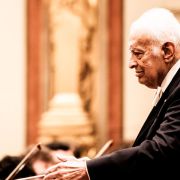
At the Musikverein, where tradition can sometimes feel like routine, Thursday night’s concert with the Vienna Philharmonic under Zubin Mehta offered something rarer: a palpable sense of history, distilled into sound. Now approaching his 90th birthday and visibly frail, Mehta – long associated with the orchestra over decades of collaborations, including regular appearances at the Salzburg Festival and New Year Concerts – was assisted to the podium in a wheelchair and conducted seated, with minimal gestures. Yet when he turned to the audience, he beamed; and when the music began, what followed was less about physical command than about trust.

The Vienna Philharmonic, an ensemble known for its independence, responded with extraordinary attentiveness, playing not just precisely but with what felt like a kind of collective devotion. The program, a testament to that comfort, felt like a gathering of old friends. Huge credit is overdue Concertmaster Rainer Honeck, whose masterful leadership provided the glue throughout.
The evening opened with the overture to Oberon by Carl Maria von Weber. The orchestra’s signature sound was immediately apparent: horns glowing without excess weight, clarinets elegantly shaped, and strings full yet never harsh – lean, articulate and sparing in vibrato.
In Bruch’s First Violin Concerto. Pinchas Zukerman joined as soloist. Zukerman made his own debut here over 50 years ago, but at a spry 77 seemed like a spring chicken next to Mehta. His Bruch was not about fastidious perfection; he brought an approach that felt almost disarmingly relaxed. His tone remains unmistakably vocal, warm, pliant and sustained. He possesses that rare ability to find every corner of the intonation spectrum, coloring each phrase with an effortlessly singing, mellifluous legato. It was a performance of perfect, relaxed authority, offering the sense that the music lives so deeply within the player that precision becomes secondary to expression.
Originally slated to feature Antonín Dvořák in the second half, the programme was altered at Mehta’s request to the Seventh Symphony by Ludwig van Beethoven – a work firmly in the shared DNA of all involved, and a work he conducted here for his 80th birthday celebration nearly a decade ago. If familiarity can breed complacency, here it yielded clarity and depth. The Allegretto, in particular, was shaped with remarkable dynamic control: hushed string textures, finely layered entries and a restrained, almost weightless, bowing that gave the movement’s inexorable tread an aching transparency. The Vienna Phil's bow-arms achieved an almost transparent restraint against its mournful, dirge-like rhythm. The dynamic differentiation as the movement built through layering was so raw, so exquisitely controlled, that it rendered the final two movements almost irrelevant. It was music-making of quiet intensity and profoundly affecting.
This was not a concert of novelty or reinvention. Rather, it brought together three artists – Mehta, Zukerman and the Vienna Philharmonic – meeting repertoire they know intimately, illuminating it through mutual understanding. The generally reserved Musikverein crowd sensed it too and responded with a rare unanimity, offering a standing ovation filled with gratitude.