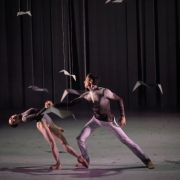
Devised by Filip Barankiewicz, Artistic Director of the Czech National Ballet and a former principal dancer of the Stuttgart Ballet, Avant-Garde is an original triple bill built around Jiří Kylián’s 27’52”, with two new works for the company by Robert Bondara and Marco Goecke. The programme unfolds as a meditation on transience, instability and the unpredictability of human life. Eclectic throughout, music becomes one of the evening’s main structural threads, superbly shaped by conductor Jaroslav Kyzlink and the National Theatre Orchestra.

Bondara’s 4 Seasons, set to Max Richter’s recomposition of Vivaldi’s The Four Seasons, opens the evening, its choreography closely attuned to the score’s repetitions, minimalist pulse and accumulating patterns. Long drawn to this music, Bondara reportedly arrived in the studio with a clear overall structure already in mind. The curtain rises on thick fog, from which emerges Nelly Danko (Ukrainian born former soloist and longtime ballet master with National Theatre Ballet in Prague) gently stroking origami birds suspended from the ceiling.
Bondara’s use of stage elements is especially striking: paper birds, white blocks rearranged throughout as seats, supports and platforms, and white vertical plastic strips forming the backdrop. Fire also appears as some of the birds are set alight, prompting a murmur of amazement from the audience. Daniel Tesař’s lighting gives the stage a strong chiaroscuro. The dancers, in costumes that darken as the seasons turn, move with athletic elegance.

Bondara’s language reworks neoclassicism in distinctive ways: the women dance on pointe, backs pitch forward, limbs fly outwards and dancers sweep across the stage in rapid runs. Ensemble passages unfold in canon through repeated and varied movement patterns, echoing the music and suggesting the inexorable passage of time. The principal couples are given highly physical pas de deux, full of inventive lifts and daring partnering, and Nina Fernandes stands out for her technical assurance, intensity and stage presence. Quiet melancholy permeates the ballet, culminating in the image of the white-haired woman disappearing alone into the backdrop, while nature’s cycle continues beyond the fragile limits of human life.

Created in 2002, Jiří Kylián's 27’52’’ remains powerfully relevant today, exploring the tension between the human soul and the passage of time, with the title itself stating its exact duration. The performance begins with the dancers warming up while the audience is still in full light. As the music intensifies and the lighting subtly dims, the audience is drawn almost imperceptibly into the ballet. Dirk Haubrich’s score, composed for the work, draws on the structure and atmosphere of Mahler’s unfinished Tenth Symphony, creating an electronic landscape of ruptures and rhythmic shifts.

Kylián’s movement language balances continuity and disruption: movements surge with sudden energy, then forearms and lower legs are isolated, trembling and shivering. Performed in two casts, the ballet found especially strong interpreters in Kristýna Němečková and Patrik Holeček, and Aya Watanabe and Giovanni Rotolo, as the red couple, perhaps the most demanding roles in the work. All the dancers were exceptional, with special mention for Matěj Šust in the purple role, who embodied Kylián’s style with personality and conviction. The set again plays an essential role, above all through the unstable floor panels, which become part of the ballet’s choreographic language. In the final moments, bodies are swallowed beneath them, only for the structures above to collapse in turn, leaving an image of tragic finitude.

In Lovebirds, Marco Goecke sets Bohuslav Martinů against James Brown, using speech and musical disjunctions for a choreography shaped through close collaboration with the dancers. A man in a corset appears to the rhythmic cadences of a James Brown interview, moving in jerky, robotic bursts. Everything is recognisably Goecke: rapid arm movements, nervous tremors, and an almost suffocated repetition that gives the body a self-punishing quality.
Created for 18 dancers, men and women alike wear corsets that accentuate the shoulders and arms with eerie tenderness; three men wear blazers adorned with red flowers, while another dancer is covered in tattoos. Lighting by Udo Haberland brings out birdlike movements and fleeting flock formations. Out of this tense atmosphere emerges the image of a society under strain, in which intimate disturbance becomes painfully visible, and where love offers, at best, only a fragile glimmer of light. Even then, interaction remains frenetic and frayed: couples meet uneasily, engaging in reciprocal adjustments rather than genuine encounters. As bodies gather and disperse in clusters and fragile attachments, intimacy surfaces, but always exposed to fracture and danger.

Lovebirds becomes a moving study of closeness under pressure, of vulnerability and desire in a world that offers little shelter. Voices recur throughout as disarticulated sounds and disquieting messages (‘there is a bomb!’), and at the end a man, after his solo, utters a placid, formal ‘goodbye’, prompting an amused smile from the audience.
Rudolf Nureyev recalled a life-changing encounter with ballet when, at the age of seven, he saw Song of the Cranes in Ufa on New Year’s Eve 1945, mesmerised by the colours, music and magic of the performance. Beside me, a little girl, perhaps about the age Nureyev had been then, frightened by Kylián’s music and the nudity on stage, asked her father to leave.

Not every work needs to be for everyone, and art need not only enchant. Sometimes it speaks by unsettling us, forcing into view what we might otherwise prefer not to face. If these works speak so vividly to the present, they do so not by consoling us, but by confronting us with instability, anxiety and finitude. But disturbance alone is not enough. Art begins to matter when it gives shape, necessity and resonance to what it unsettles. At its strongest, this evening gave precisely that kind of form to unease.
Elsa’s press trip was sponsored by Czech National Ballet