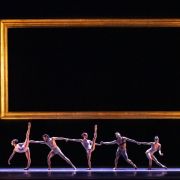
Created 17 years ago for the Staatsballett Berlin, Caravaggio stands as one of the defining works in the oeuvre of the Roman choreographer Mauro Bigonzetti. Since 2025, the ballet has been presented in Italy in its complete version at Teatro del Maggio Musicale Fiorentino, Teatro Arcimboldi in Milan and Teatro Regio in Turin. It now also enters the repertoire of Palermo's Teatro Massimo and its revitalised ballet company under the artistic direction of Jean-Sébastien Colau.

It is one of the landmark works of contemporary Italian dance, embracing with remarkable assurance and completeness, the distinctive resonances of every perspective and every gesture conceived to evoke the eventful life of Michelangelo Merisi, better known as Caravaggio. One of the ballet's greatest strengths lies in Bigonzetti's deeply considered interpretation of the painter's biography, where space, time, sound, the body and theatrical representation are woven together with exceptional subtlety. These themes find their most accomplished expression in the dialogue between light and shadow – those defining hallmarks of Caravaggio's art – which Bigonzetti's choreographic aesthetic explores with striking intelligence and compelling effectiveness throughout the work's two acts.

After Vladimir Malakhov, it is Roberto Bolle who takes on in Italy the story of the Lombard painter, also doing so in Palermo, where he returns to the Teatro Massimo after a nineteen-year absence. In the opening four performances, the Italian étoile receives unanimous acclaim, praise and admiration alongside Maria Khoreva, first soloist of the Mariinsky Theatre in Saint Petersburg, who had already appeared in the earlier productions in Florence, Milan and Turin.

For the final two performances of this third production in the Sicilian opera house’s dance season, one of the company’s leading dancers will take on the title role, becoming the third male performer to take on the title role in Bigonzetti’s Caravaggio. Alessandro Casà is, in fact, the performer who succeeds with apparent ease in weaving together memory, individuality and sensibility through a choreographic language and dynamic of refined expressivity. Alongside him, entrusted with the task of giving depth to the artist’s restlessness and genius, Martina Pasinotti, in the role of Light, shapes Bigonzetti’s reworking of pure academicism, balancing counterweights and softened lines with outstanding lightness and finesse. Equally compelling is the striking dramatic intensity achieved by Alessandro Casà in his interaction with Yuriko Nishihara in the role of Beauty. Their performances are so convincing that one is left wondering: when will these three artists be promoted to principal dancers?

Notable for his ethereal presence and impassioned engagement is Alessandro Cascioli, cast as Fate, alongside Francesco Curatolo as the Soul. In both acts, the corps de ballet’s tightly synchronised execution is equally striking in the passages drawn from Claudio Monteverdi’s repertoire and reworked by Bruno Moretti, which convey with remarkable solidity the dramas, sensibility and refinements of Caravaggio’s world.

The next dance appointment in Palermo is scheduled for the summer season, with two performances of Tango and Dance Gala Evening. Guest dancers Jevgeni Grib and Marta Navasardyan of the Estonian National Ballet, together with Holly Dorger and Jon Axel Fransson of the Royal Danish Ballet, will be joined by Palermo’s own dancers in a programme that, alongside selected excerpts from the repertoire of Marius Petipa and George Balanchine, will feature works by Victor Gsovsky, Jean-Sébastien Colau, Vincenzo Veneruso and Jevgeni Grib.
Vito Lentini’s trip was funded by Fondazione Teatro Massimo di Palermo