Sir Wayne McGregor’s latest triple bill for The Royal Ballet, titled Alchemies, includes a much anticipated world premiere and was a fine example of one of his greatest skills: the art of collaboration. Diaghilev would have approved. All three works are strikingly designed, costumed, lit and, above all, performed with astounding expertise and beauty. And while they are deliberately abstract, there is a difference in mood and atmosphere. I think it’s fair to say that he is exceedingly demanding of all those involved and that the cast are still standing at the final curtain call is formidably impressive.

Untitled, 2023 opened the evening and immediately struck a chord with the stark white and green set design by the late Carmen Herrera and handsome complementary costumes by Burberry. Aesthetically soothing on the eye, with similarly tranquil score by Anna Thorvaldsdottir, the dancers were at once sublime and invested in McGregor’s extreme vocabulary. From Joseph Sissens’ opening solo to Calvin Richardson’s powerful closing one, there was much to admire in the quality of the performances. Melissa Hamilton, William Bracewell and Fumi Kaneko embodied the McGregor thrust which is his signature motif. Choreographically Untitled offers some of McGregor’s best sequences only occasionally marred by bursts of incongruous classical tropes – namely a series of fouettés. Never a good idea…

Second on the bill was the highlight of the evening, McGregor’s 2018 Yugen. This was by far the most successful offering partly because of Leonard Bernstein’s Chichester Psalms, where the Royal Opera Extra Chorus and especially treble soloist Alexander Wright were all consuming. The music added an extra layer of emotional context which the cast fully embraced. Amid a roster of superlative performances, Marco Masciari was exceptional. A word too for Edmund de Waal’s stunning set designs and Lucy Carter’s atmospheric lighting which frames the dancing elegantly.

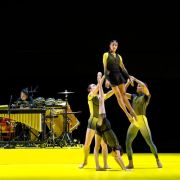
After a protracted interval, the curtain went up on Quantum Souls. McGregor is credited with concept, choreography and design. The stage was bare but for a platform housing a great many instruments. With a score by Bushra El-Turk and an exuberant, intoxicating performance from percussionist Beibei Wang who more or less danced her way through the various sounds, she remained the constant focus.

The start of the piece saw the cast of twelve gently warming up in semi-darkness. Eventually Sissens, Emile Gooding and Marianna Tsembenhoi launched into some vigorous movement, breathtakingly good. The light became yellow and bright, highlighting Saul Nash’s beautiful, individual costumes. As the rest of the cast joined in, at various moments altogether, then executing solos and duets, it was sometimes difficult to know who to focus on.

Hamilton and Bracewell were once again dazzling vehicles for McGregor’s choreography. Lithe, flexible and intense, and in spite of the often aggressive nature of the movements, always remaining graceful. It was good to see Harris Bell given an opportunity to prove his versatility too.
There were some stand out moments throughout but there was also a staggering lack of cohesion. The biggest problem I had was the almost total absence of connection to the score. One of the most pleasurable and important aspects of watching a dance performance is the symbiotic relationship between the dance and the music. There was a sense that the two were alternately chasing each other, never quite managing to catch up.

While one could not imagine better dancers to work with, much of the evening’s choreography was a regurgitation of previous steps. One could argue that pure classical ballet is just that, but because of the musical driver, it somehow doesn’t appear so repetitive. The over 180º penché arabesques, extensions à la seconde that verge on distortion or someone going into splits at various points in the proceedings just doesn’t sustain my interest. While one has to admire McGregor’s risk-taking, his totally cerebral approach to creation and his thirst for the new, certainly on this occasion, there were gaping holes in the finished product.