For direct connections, it would be hard to surpass the program the Czech Philharmonic chose to open its 131st season. Antonín Dvořák conducted the orchestra in the Prague premiere of his Seventh Symphony in 1885. And Dmitri Shostakovich was in Prague in 1947 to play his Second Piano Trio with violinist David Oistrakh, to whom he dedicated his First Violin Concerto. The two pieces offered interesting contrasts of composers facing different pressures and expectations, though more than anything else, it showcased the remarkable bond that Chief Conductor Semyon Bychkov has forged with the orchestra over seven seasons.

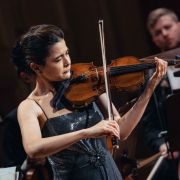
Karen Gomyo was the soloist for the concerto, written at a time when Shostakovich was under serious censure by the Soviet regime – so much so that it was kept under wraps and not performed publicly until two years after Stalin died. Gomyo is a disciplined player who captured the pathos of the piece without sacrificing any of its rigor, mirroring the emotionally taut state of the composer. Showing impressive technical command, she fired off slashing, saber-sharp lines that set a torrid pace and tone. Like an athlete, Gomyo uses her entire body in performance, which gave her playing a fierce intensity even in the softer moments of the Passacaglia. And her attention to detail was remarkable.
Bychkov was no less attentive to details, rendered in fine balance and precision amid captivating atmospherics. The textures in the opening movement were like a mist floating behind the soloist, taking on color and character in the second movement and then developing a steady pulse to anchor powerful emotional expression by Gomyo in the third. Bychkov’s control of the sound was exquisite, not just complementing the soloist but building to unified emotional peaks that held the audience spellbound at times. That made for a thrilling finale, brimming with energy and anguish in every bar.
The 40-minute concerto makes heavy physical demands of the soloist, so it was a bit of a surprise when Gomyo came out for an encore. A cooly proficient rendition of the Double from Bach’s Violin Partita no. 1 in B minor let the audience down gently after the searing concerto, but the subdued treatment suggested that she was out of gas.

Bychkov opened the Dvořák symphony in grand dimensions, with immediate depth and power, and kept it that way throughout. Crescendos rose and crashed with explosive force, and the sound grew so dense that by the final movement the melodies had to sneak through. While there was no denying the impact and excitement of this approach, the emotional core that typically characterizes the orchestra’s signature style seemed missing. Especially after Bychkov’s riveting interpretation of the concerto, which seemed to come straight from his soul, this sounded like a skillful but standard treatment that could be heard almost anywhere.
Which may be a compliment. At the time he wrote the symphony, Dvořák was trying to move beyond his Slavonic roots and break out as a composer of international stature. He achieved that when the world premiere of his Seventh Symphony in London (seven months before the Prague premiere) was greeted with what he described as “pandemonium after every movement, rousing to the very end”. That was not quite the reaction at the present-day Rudolfinum, but the international flavor of the piece was unmistakable, and as a reflection of the fine-tuned relationship Bychkov has forged with the orchestra, an achievement in itself.