This Sunday matinee performance by the City of Birmingham Symphony Orchestra at Birmingham Town Hall promised to be a standard fare of Bach and Beethoven, with two concertos bookended by an overture and symphony. It was billed heavily as Bach and Beethoven, but a curious decision was taken with the programme to include Magnus Lindberg’s Violin Concerto no. 1. In recent years, social media algorithms have become increasingly slick at generating recommendations for future listening based on consumer preferences. It is difficult to imagine this programme recommendation coming from such an algorithm and, despite the superb musicianship, the overall experience of the concert seemed somewhat disjointed.

From the outset, with Beethoven’s Creatures of Prometheus overture, the CBSO were in good form as usual. The strings were rich and in perfect unison, and François Leleux managed to maintain the sense of heroic tension and hopeful promise of the Promethean myth throughout, where the ability to create fire is no longer under the sole control of the Olympian gods, but handed to us mortals.
After warming us up nicely, we were exposed to the cold of the Finnish landscape with Lindberg’s concerto. The soloist, Lisa Batiashvili, painted a picture in sound with her instrument onto the sparse orchestral canvas laid out by Leleux. This is not a concerto of melodies, rather an ambient poem in the greyish-blue monochrome of winter. Batiashvili’s virtuosity brought chilling high notes that cut through the acoustics of the hall, fluid passages that trickled like an ice water brook and rhythmic motifs that seemed to strain to break free from the frozen wasteland. There is certainly intensity in the way the composition evokes atmosphere and imagery. However, it struggled to maintain the initial interest, seemingly having nowhere it especially wanted to go, and its lack of warmth was uninviting. Concentration began to return toward the end of the 26-minute work, performed as one continuous movement. There were some signs of a thaw, a glimmer of warmth emanating from the woodwinds in small chorales, as if sunlight was beginning to glow as an aubade promising the break of day.

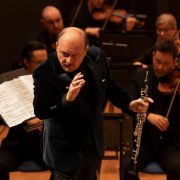
Leleux rested his baton on the podium after the break, emerging with oboe in hand to lead a reduced orchestra in Bach’s Oboe Concerto in D minor, BWV1059. He handled the tempi of the Allegro and Presto movements perfectly: fast enough to dazzle, slow enough to allow the phrases to dance. The Adagio, with its well-known cantata tune “Ich stehe mit einem Fuss im Grabe”, was played with sublime lyricism and tonal warmth, proving to be my highlight of the afternoon.
Returning to the podium, Leleux conducted Beethoven’s Fourth Symphony with the same focus on drawing out the lyrical qualities of the work, mainly from the woodwinds. There were some balance issues, bassoons barely audible beneath the strings, but the flutes played with confidence and the full dynamics were brought to the fore with conviction in the finale. The effect of the more familiar and energetic Bach and Beethoven works in the second half was akin to warming us up in front of a cosy fire after exposure to the Finnish winter.