Why is it that you wait ages for a performance of a rarely heard masterpiece and then two (actually four) come at once, like London buses? This September, the NHK Symphony Orchestra and the Tokyo Symphony Orchestra are both giving two performances each of Franz Schmidt’s Das Buch des sieben Siegeln – a massive biblical oratorio based on the Book of Revelation – only a week apart! One could say it’s bad planning and that orchestras should talk to each other more about their season programming, but at least, once they found about the clash, the two orchestras have carried out joint promotional activities about the concerts, which can only be a good thing.

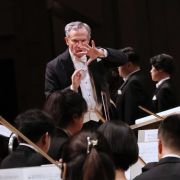
It was Fabio Luisi and the NHK Symphony Orchestra who kicked off this Schmidt extravaganza. The concert was also their season opener. In a way, it wasn’t a surprise that Luisi, their Music Director, chose this work because he is probably the leading advocate for Schmidt’s music in recent years, and he conducted the Fourth Symphony No. 4 last season. Still, Das Buch des sieben Siegeln is on a totally different level, requiring a large orchestra, organ, chorus and six soloists. The orchestra was performing it for the first time.
True to form, Luisi’s expertise in this monumental work shone through the performance. From the opening bars, he was lucid yet passionate and led the large and diverse forces with rigorous control and excellent pacing. The oratorio is in three (continuous) parts, and the role of John (Johannes) narrates the vision of the breaking of the seven seals and the Last Judgement while, in between, the chorus and orchestra depict the various scenes vividly. Stylistically, Schmidt draws on everything from Gregorian chant and Bach to Bruckner and Wagner. His choral and orchestral writing is sometimes mindbogglingly complex (eg. a quadruple fugue) but sometimes lyrical and affecting (eg. the mother and daughter duet and the Gregorian chant-like male chorus).
To be honest, for a non-Christian Japanese listener like me, it is not easy to grasp the symbolism of the seven seals or the sounding of the seven trumpets, but the scenes of the earthquake, famine or the war and destruction were truly terrifyingly depicted in this performance. Luisi’s decision to perform the 110-minute work without a break must have been challenging for the performers on stage but it was an equally challenging and tense listening experience.

The role of St John was sung by Michael Laurenz, a character tenor known for his portrayal of roles such as Loge and Mime. Whether he fits the description of the Heldentenor specified by Schmidt in the score is debatable, and his steely voice needed getting used to, but his storytelling was vivid and convincing, maintaining the intensity through the 110 minutes. Meanwhile, bass David Steffens sang the Voice of God with sonority and authority from the organ loft, situated on the upper right-hand side of the stage. The other vocal parts were impeccably sung by a quartet of Japanese singers. In particular, soprano Miho Sakoda and mezzo Asami Fujii excelled in their mother and daughter duet in Part 1. The 120-strong New National Theatre Chorus were on top form – the various complex fugues, including the quadruple fugue, were sung with brilliance and remarkable clarity. The orchestra played their hearts out too, with special praise to the brass section which played a key role in the Last Judgement scene. One must also mention the impressive solos from organist Eri Niiyama. Altogether, it was the sheer sonic power and the monumentality of Schmidt’s musical vision that left me stunned at the end. Let’s see how Lorenzo Viotti and the Tokyo Symphony fare with the work next weekend.