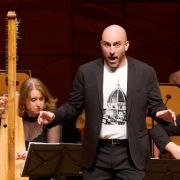
The title “Italian serenatas” is a little misleading in light of the technical meaning of “serenata”, but this Australian Brandenburg Orchestra concert was certainly Italian. Conductor Paul Dyer introduced the evening as being about fun, which it certainly was, but not only that. The main draw was Italian “baritone and bass” Renato Dolcini who augmented his impressive vocal skills with charisma and a fine sense of theatre.

The concert was structured into four sections: Firenze, Napoli, Roma and Venezia. There was also a sub-theme featuring the ciaconna (chaconne). The opening segment began and ended with concerti grossi by Giovanni Lorenzo Gregori, whose connection with Florence is rather obscure as he was born, lived and died in Lucca. The Adagio e staccato provided a crisp opening to proceedings, with the usual string line-up augmented by timpani and an attractive harp in the continuo along with guitar and theorbo, plus a charming violin solo from Matthew Greco.
The ABO segued into the first vocal contribution, a relatively light hearted ciaccona-style song, Amanti, io vi sò dire by Benedetto Ferrari (whose connection with Florence is equally tenuous). Dolcini ambled on to the stage in a black suit over a white T-shirt featuring a duomo, presumably a Florentine one. He thus marked each section, rocking a white suit for Naples over a black T-shirt with Vesuvius, a green suit for Rome over a Colosseum motif and a blue suit for Venice over the Rialto Bridge. His rendition of Amanti was highly expressive and dramatically engaging, particularly the recitative verse, while displaying lovely bronze tone, accuracy and flexibility with lightness of touch.
The Napoli segment did feature composers from Naples, starting with a Ciaccona by Andrea Falconieri, which segued into an aria from Nicola Porpora’s serenata Deianiera, Iole ed Ercole. “Ombre oscure” was beautifully delivered, with a lovely messa da voce on the da capo. A short instrumental work by Nicola Matteis characterised as Sarabanda or Ciaccona led into another Porpora aria, “Se lusinga il labbro e ‘l ciglio” from the cantata Oh se fosse il mio core. Many of the arias sung here by Dolcini were in fact written for alto or soprano voices, one presumes because many of the bass arias of the 17 and 18th centuries were not particularly bravura, being written for fathers, priests, generals and such (although Handel, and indeed Bach, wrote some crackers). This is not to say it wasn’t well sung, but one can’t help but feel that this aria is better suited to a higher timbre. The following light hearted “pizzica” – a form of tarantella – was a most entertaining finale to the first half.

Moving on to Rome, we heard from Corelli, bracketing an anonymous passacaglia, Homo fugit velut umbra, a kind of vocal danse macabre. Handel’s opera Agrippina, was written during his Italian period, albeit for La Fenice in Venice. The short but beautiful aria “Vieni, o cara” sheds a new light on the rather buffoonish Claudio, sensuously delivered by Dolcini. Antonio Caldara was in Rome long enough to write an oratorio, La Castità al Cimento, from which we heard the aria “Sparga il senso lascivo veleno”.
There is no disputing Vivaldi’s association with Venice, with three works starting with two movements from the Sinfonia in C major, RV 116, followed by two arias, the despairing “Gelido in ogni vena” from Farnace and one calling for more vocal fireworks, “Per lacerarlo” from Teuzzone, delivered with all the coloratura highlights one would wish. As an encore, Monteverdi’s song Sì dolce è’l tormento, sung with subtle phrasing, cemented Dolcini’s versatility.