Kazuki Yamada seemed to have turned up at Symphony Hall with just one thing on his mind on Thursday evening: melody. This was a City of Birmingham Symphony Orchestra concert that positively luxuriated in line, but as celebration rather than indulgence.

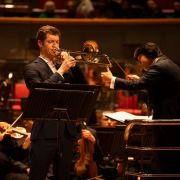
That being said, indulgent was certainly a quality permeating Dai Fujikura’s new Trombone Concerto, receiving its UK premiere. Subtitled “Vast Ocean II”, and supposedly inspired by Vladislav Lem’s novel Solaris, there was no escaping its relentless, incessant lyrical impulse. All the trombone seemingly wanted to do was obsess for 20 minutes over a never-ending melody. For a time it was modestly pretty, but it didn’t take long to become mundane, articulated as it was with the most straightforward musical language. Considering the beguiling inspiration of the work – Lem’s Solaris is strange, uncanny, beautiful but elusive – Fujikura’s work was bafflingly prosaic. It was at its most interesting when Peter Moore’s trombone fell silent, allowing the orchestra to move beyond mere support, revealing a more adventurous side, but these occasions were frustratingly few, and brief.
Yamada rendered Mahler’s Blumine – originally the second movement in an early version of Symphony no. 1 in D major – as a self-contained tone poem, which worked superbly well. It had space to speak on its own terms, at the same foreshadowing the concert’s second half. The emphasis on its lyrical lightness, at the beginning and end, clarified anew why Mahler removed it from the symphony (effectively re-hashing what the opening movement already achieves) while the work’s core was made arrestingly introspective.
As for the symphony itself, the famous opening was spine-tingling, Yamada triggering the CBSO to begin with the most slight of gestures. The drama here was palpable, treating the exposition as a gradual awakening from sleep, warming up through the repeat, gaining energy all the time. The unexpected intrusions of menace that occur later were sombre and impressively unsettling, though were ultimately shrugged aside as the music moved inexorably to a glorious recapitulation of pure joy, the main melody fizzing with life and laughter.
Yamada and the CBSO really made the symphony their own in the two central movements, both of which were treated in a very measured manner. This had the effect of emphasising the music’s folk origins, making the Ländler lilt in the Scherzo a cross between a dance and a song, only pressing forward at the climaxes, preferring to revel in line rather than rhythm. Likewise the slow movement, where the players made clear each and every part of its interweaving, darkly contrapuntal Frère Jacques canon. Furthermore, the Klezmer music spoke as something serious despite being relatively upbeat. As such, it fitted perfectly within this velvety processional of point and counterpoint, lines echoing lines, where everything, everywhere, was a tune.
One of Yamada’s key strengths is to make one hear familiar music in genuinely new ways. The end of this slow movement, rather than sounding burned out and exhausted (as if often does), here seemed pent-up and tense – not really an ending at all. The sudden start of the finale therefore made complete sense, an overwhelming rush as all that energy was finally released, unleashing its storm with full, tumultuous force. Only after this was there a tone of exhaustion, the gentler music not sounding (again, as it often does) as relief – still less relaxation – but as a dazed aftermath. The conclusion, unlike the first movement, was thus hard-won, not remotely inevitable, Yamada even emphasising the structural strangeness at its core before pushing on, hard – practically fighting – to bring about the symphony’s triumphal peroration. Line as victory.