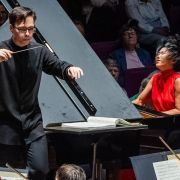
Curious musicians periodically set themselves small challenges. Pianists in particular have their own special hills to climb such as performing Bach’s Goldberg Variations from memory, or back-to-back performances of Beethoven or Rachmaninov’s concertos in one day. Yuja Wang’s latest project takes her into a small group of pianists who delve deep into the world of Johannes Brahms by performing both his monumental piano concertos on the same evening. After a taster in Louisville last week as both soloist and conductor, Wang headed to the Netherlands for the first of two concerts with the Rotterdam Philharmonic joined by their Principal Guest Conductor Tarmo Peltokoski. How would she approach this marathon affair? Which concerto would leave the lasting impression, and would she have something meaningful to say about a composer and genre whose music she openly shied away from in her earlier years?

As is so often the case in the finest concerto performances, collaboration was at the heart of Rotterdam’s Brahms-fest. Performing entirely from memory (her trusty iPad was nowhere to be seen until the encore) Wang’s opening phrase entered with a deathly whisper ensuring that audience and orchestra alike would fall under her magical spell. Both soloist and conductor were reading from the same page, even if the latter sometimes had to work just that little bit harder to enforce his will. Written in the backdrop of Robert Schumann’s failed suicide attempt, Wang told a story of hope as relevant today as when Brahms penned his First Concerto more than a century and a half ago. The Second seemed more considered and thoughtful, yet still oozed skittish playfulness binding almost a lifetime’s worth of emotion into one. Colourful bell-like chimes, moments of wild abandon, wonderful stillness, mystical intrigue and graceful elegance left nobody in any doubt about her commitment to revealing the core of Brahms’ intention.
Much is made of Wang’s astonishing technical prowess, but it is only when delving deep into the respective scores that the fullness of the task in hand becomes clear. Quite simply, Wang makes the fiendishly difficult sound easy, whether it be magical runs traversing the entirety of the keyboard in a flash, or towering fistfuls of chords laden with tricky cross rhythms and syncopations pitting grandeur and might alongside the raw emotion of delicious dissonances and lingering suspensions. Even the tender caress of descending sequences emerging from behind dark clouds spoke the universal language of love.
In Wang’s hands, Brahms’ complex musical language just sings. And in delving deep, she brings out the very best of those around her. Never more so than the horn’s exquisite opening theme to start the second concerto, echoed in the piano’s response as her searching and sustained left hand counterpoint told a very different tale of hope. Or the cello’s stunning invitation to start the Andante matched seamlessly by bassoon and oboe before, underpinned by a pedal horn, the piano takes the reins building swiftly towards a passionate embrace, possibly the most beautiful moment in the whole of Brahms’ oeuvre.
Did she have a favourite? I could not tell. Her love for both seemed overwhelming, and my respect for her art grows.