After Semyon Bychkov was named incoming Chief Conductor of the Czech Philharmonic, he immediately added Smetana’s Má vlast to his programming to learn the work in depth. Now he likes to say that performances of the piece are a blend of his interpretation and the orchestra’s native feel for the music. Which is exactly how it sounded in a Dvořák’s Prague concert that included soloist Yunchan Lim playing Ravel’s Piano Concerto in G major and a bracing invocation of the festival’s namesake.

Dvořák’s Carnival overture opened the evening in high spirits, with Bychkov setting a fast pace at peak volume. The big driving sound occasionally buried some of the musicality, in particular golden strings and whirling woodwinds that were exhilarating in the quieter passages. Hitting the percussion hard propelled the dance rhythms, with a frothy finish to the sound adding a euphoric touch. The blend was clear in this work as well – the orchestra playing with a deep feel for the folk roots, the conductor giving the music a classical cast.
Shifting gears, Bychkov served up a modern reading of the Ravel concerto, precise, finely detailed and richly expressive. He showed a deft hand with the intricacies of the sound effects and timing, crafting accompaniment that was brisk and colorful, captivating music in itself. The jazz influences Ravel had picked up during his visit to America were clear and convincing. And the sensitivity and enthusiasm in the playing gave the piece spontaneity and flair.
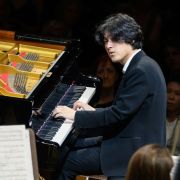
Yunchan Lim’s performance, alas, did not match the orchestra’s. There is no question about his technical command of the concerto; his fingerwork was dazzling and his playing was at a high level. But it sounded uninspired, even plodding at times, especially in the solo opening of the second movement. Overall his sound was heavy, especially in contrast to the orchestra. Lim has a shy stage manner, barely making eye contact with the audience, even when he’s taking bows. As an artist he is entitled to whatever posture he prefers, but in this case it added to the sense of detachment, an appearance that was mechanically note-perfect but lacked soul.

Intermission provided a needed breather and set the stage for a treatment of Má vlast that was a revelation. Only the first three movements were performed, but they were enough to show how the nationalist elements in the piece could be rendered with rigor in a vivid visual style that makes the music universally accessible. Crisp harps opened Vyšehrad, and throughout the entire movement Bychkov struck a fine balance between emotional yearning and disciplined playing. Vltava (aka The Moldau) sounded as it should – sparkling and flowing and occasionally choppy, like a boat ride, with colorful depictions of scenes onshore. Šárka brought the warrior maiden to life with martial rhythms and vibrant sounds of battle, ending in an explosive finish.
Bychkov looked exhausted when he finally turned to the audience for applause, which was no surprise. He gives his all on the podium, especially for music close to Czech hearts. On this occasion he and the orchestra showed that even for familiar music they have performed many times in their home hall, they can bring something special.