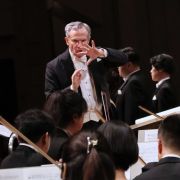


Affectionately known as ‘Kobaken’ to Japanese classical music fans, the octogenarian conductor Ken-Ichiro Kobayashi is one of the busiest conductors on the Japanese concert circuit. His concert with the Japan Philharmonic Orchestra at Tokyo’s Suntory Hall on 26th October will mark his 500th appearance at the prestigious venue, which coincidentally is celebrating its 40th anniversary this year. Kobayashi’s first appearance there was in July 1987, less than a year after the hall opened, when he conducted the Japan Philharmonic in a programme of popular masterpieces including Rimsky-Korsakov’s Scheherazade and Ravel’s Boléro. Coming full circle, he returns to these pieces in this 500th concert with the orchestra with which he has maintained the longest relationship.

I ask Kobayashi what he remembers about performing at Suntory Hall for the first time. “Well, in those days there was no concert hall dedicated to classical music in Tokyo. The venues were all multi-purpose. Tokyo Bunka Kaikan had reasonable acoustics, but the other halls were pretty poor. In Europe, I had many opportunities to conduct in the Amsterdam Concertgebouw with the Netherlands Philharmonic, and when I first conducted there, I was astonished that the sound of the orchestra in the hall could be so beautiful. Then, when Suntory Hall opened in 1986, I remember thinking a magnificent concert hall, on a par with the Concertgebouw, had been built in Tokyo.”
Kobayashi’s close ties with the Japan Philharmonic Orchestra go back to one of his conducting teachers, Akeo Watanabe (1919–1990), who was among the founders of the orchestra in 1956. Sibelius aficionados may be familiar with Watanabe’s name through his groundbreaking 1962 Sibelius cycle with the Japan Philharmonic, which was the world’s first recording of Sibelius’ complete symphonies. It was Watanabe who gave Kobayashi his first opportunities to conduct this orchestra, and subsequently in the late 1980s, when Watanabe became ill, he asked the younger conductor to take over.


Kobayashi took up the position of chief conductor in 1988, a position he held on and off until 2004, when he became the orchestra’s music director (until 2007). Even after he stepped down from the post, he has maintained strong ties, and he has given around 340 concerts at Suntory Hall with the Japan Philharmonic in the past 40 years. This statistic is pretty amazing.

Although Suntory Hall doesn’t run a resident orchestra system, one could say that the Japan Philharmonic enjoys a privileged position because it holds its monthly subscription concerts at Suntory Hall. Shortly after the hall opened, the Japan Philharmonic moved its Tokyo subscription concerts to Suntory Hall, and basically ever since, they give two concerts of the same programme every month, as well as special and seasonal concerts. One could probably say that Kobayashi and the orchestra know this venue like no other.
“The atmosphere of the hall is sublime. When the musicians perform in Suntory Hall, their attitude is different and they even sit differently. We all feel that the music we are able to create here in this special hall is a gift from heaven.”
Looking through the Suntory Hall performance archive, Kobayashi’s orchestral repertoire spans all the symphonic masterpieces: from Mozart to Mahler, Beethoven to Brahms, Smetana to Sibelius, and everything in between. He also conducted music by contemporary Japanese composers – in fact, at Tokyo University of the Arts he initially studied composition. Unsurprisingly, the work he has conducted most at Suntory Hall is Beethoven’s Symphony no. 9 with 59 performances. As many people will know, the work has a special place in Japan’s end-of-the-year celebrations (rather like the Messiah in the UK). He conducts the work at Suntory Hall twice this December.
Some readers may be aware that Ken-Ichiro Kobayashi is particularly highly regarded in Hungary. In fact, his career as a conductor was launched in Budapest when he won the Grand Prix at the first International Conducting Competition in 1974, organised by Hungarian Television. Kobayashi tells me that because of the TV broadcast, he immediately became a familiar face in Hungary and was recognised everywhere. After the competition, he served as assistant to János Ferencsik at the Hungarian State Symphony Orchestra (now Hungarian National Philharmonic Orchestra), later succeeding him as principal conductor of the orchestra (1987–97). As Conductor Laureate, he has been regularly invited back to Hungary.
Kobayashi recalls the first time he brought the Hungarian State Symphony Orchestra to Suntory Hall in 1988, shortly after becoming its chef. “In those days, we used to perform in the Congress Center Hall in Budapest which had poor acoustics (nowadays there is Müpa of course), and at rehearsals I was always struggling to get the orchestra to produce a resonant sound. For the tour, I specifically chose Berlioz’s Symphonie Fantastique which lends itself to resonance, but I needn’t have worried. In a hall with bad acoustics, the sounds are brittle and just fade abruptly, but in Suntory Hall the sounds resonated, and they could produce the most beautiful soft sound without any difficulty. One just had to play softly, and the most gorgeous pianissimo sound wafted through the hall. The musicians were astounded. I think this experience of playing in Suntory Hall helped their playing back home too.”


In addition to Hungary, Kobayashi has also had strong ties with the Czech Republic and the Netherlands. He was guest principal conductor of the Czech Philharmonic in the 1990s, becoming the first Asian conductor to conduct Smetana’s Má vlast at the Prague Spring International Music Festival in May 2002. In 2006, he became the principal conductor of the Arnhem Philharmonic Orchestra in the Netherlands (Het Gelders Orkest, now part of Orkest Phion). When he brought this orchestra to Japan in 2007, he organised a joint concert with the Japan Philharmonic at Suntory Hall, which consisted of almost 160 players on stage performing a programme including ‘Vltava’ from Smetana’s Má vlast and Tchaikovsky’s Pathétique Symphony. He tells me he was very struck by how different the characters of the two orchestras were.
I ask him whether he has a routine when he performs at Suntory Hall. “On the day I’m performing at Suntory Hall, I feel different the moment I wake up. When I arrive, I take a deep breath and take in the wonderful air of the hall. I feel at home conducting at Suntory Hall and I’m always very relaxed. After the rehearsal I take a nap in the dressing room. I can sleep very well.”
Kobayashi says that over the years, the audience has become quieter and more attentive. He also praises the staff – not only the hospitality of the front of house staff but the dedication of the production team – who have maintained the standard throughout its 40 year history.
Looking through the records of his 500 concerts at Suntory Hall, one orchestra caught my eyes in particular: ‘Kobaken and His Friends Orchestra’, which has given 16 concerts at the hall to date. Established in 2005 as part of the official cultural programme for the Special Olympics, it is an orchestra that brings together all types of musicians, whether professional, amateur, student or with or without disabilities who want to perform with the maestro. Usually such outreach projects tend to be institution-led rather than conductor-led, and it is a testament to his amiable and all-embracing personality, which has probably also led to the longevity of his career. The next concert of the Kobaken and His Friends Orchestra will be his 503th concert at Suntory Hall on 8th December, performing Beethoven’s Ninth. Long may he thrive!
Ken-Ichiro Kobayashi makes his 500th appearance with the Japan Philharmonic Orchestra at Suntory Hall on 26th October.
Kobayashi returns to conduct Beethoven’s Ninth Symphony on 8th & 27th December.
See upcoming performances at Suntory Hall.
This article was sponsored by Suntory Foundation for the Arts.