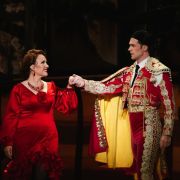
For its season-closing revival of Paul Curran’s production of Carmen, Seattle Opera is presenting alternating casts headed by Sasha Cooke and J’Nai Bridges in the title role. Cooke’s much-anticipated role debut reveals an intelligent, tightly controlled interpretation that resists many familiar clichés surrounding the character while never fully igniting the opera’s destructive energies.

Curran relocates the action to a stylized 1950s Caribbean setting, plausibly Cuba – a nod to the Habanera? – and, in tandem with Gary McCann’s set and costumes, emphasizes crowded public spaces in the outer acts, saturated in Paul Hackenmueller’s humid tropical lighting, while the smugglers’ hideout becomes a looming warehouse of gloomy industrial shadow.
Curran proves especially attentive to the opera’s broader social world and also supplies choreography for several scenes. Priests mingle with the soldiers, and a religious procession precedes the bullfight in the final act; soldiers, workers and street vendors crowd the stage, suggesting the sense of a society structured by ritual as well as by individual desire. Costumes featuring aprons, patterned dresses and bandanas for the factory women, alongside the soldiers’ khaki uniforms and high boots, evoke a mid-century working class world without tying the staging to a precise political moment.
Most strikingly, the production emphasizes the control exerted over women’s labor and bodies: the cigarette factory workers are literally locked inside their workplace. We observe Don José laboriously removing a padlock to allow them outside for their break, only to secure the gate again afterward.
An emphasis on performance shapes Curran’s treatment of Carmen herself. In Act 2, Lillas Pastia’s tavern becomes a smoky nightclub with its own performance stage, placing Carmen self-consciously in the role of entertainer. Her authority depends not simply on sensual magnetism but on a calculated projection of persona.

That conception aligned closely with Cooke’s characterization. Vocally, she brought considerable variety of color, weight and phrasing, shaping the role with intelligence and purpose. Cooke’s Carmen seemed constantly to assess the social dynamics around her, weighing each interaction for advantage. Particularly effective was the abrupt chill of her response to Don José’s crisis of conscience in Act 2; the speed with which fascination curdled into contempt had a cutting force.
Overall, Cooke illuminated Carmen’s theatrical intelligence more vividly than the opera’s erotic danger, refusing the usual vamp stereotype. The Habanera, for example, projected teasing charm rather than volatile sensuality. That approach might have registered more persuasively opposite a Don José whose transformations felt more fully charted. Matthew Cairns brought lyrical poise and urgency to the dutiful corporal, but his depiction seemed oddly fixed from the outset: José’s progression from detachment to obsessive desire failed to convince, and the pair generated little chemistry together. The violent eruptions of jealousy against Zuniga and Escamillo, and, fatally, in the final act, felt more imposed by the opera’s machinery than earned through dramatic accumulation.

Kathleen O’Mara’s Micaëla had warmth and generous vocal presence, even if a climactic phrase or two edged toward stridency. Yet José’s emotional attachment remained frustratingly opaque: their scenes together suggested dutiful obligation more than genuine inner conflict, while Micaëla’s repeated references to his mother – material that should expose deeper vulnerability and repression – instead drew uneasy laughter from the audience.
Christian Pursell sang Escamillo solidly, if not quite with the charismatic swagger needed to dominate the stage physically. Darren Drone gave his cigarette-smoking Zuniga a cynical, self-serving authority that neatly embodied the opera’s corrupt social establishment. Meredith Wohlgemuth and Melody Wilson formed an appealingly contrasted pair as Frasquita and Mercédès: their comic interplay in the card-reading scene threw Carmen’s fatalistic visions into sharper relief. As the smugglers, Navasard Hakobyan and Daniel O’Hearn brought a roguish vitality to the opera’s bohemian underworld of outsiders and itinerants.

In an opera where the chorus plays an unusually central dramatic role, Seattle Opera’s adult and youth choruses – prepared by Michaella Calzaretta and Julia Meyering – were exceptionally well integrated into Curran’s staging, projecting a vivid sense of collective public life while contributing theatrical animation and rhythmic precision.
Much of the production’s élan came from the pit, where Ludovic Morlot – the Seattle Symphony’s Conductor Emeritus, and notably absent from the orchestra’s own season this year – reunited with many of its players in the Seattle Opera orchestra. He navigated the score’s abrupt emotional turns with dramatic fluency: whether in the sudden intrusion of Carmen’s Fate motif in the Prelude or her private performance for José in the second act, where her castanet rhythms morph almost imperceptibly into the bugle calls summoning José back to the barracks.

Morlot drew unusual attention to often overlooked textures and instrumental colors without sacrificing momentum, giving space for details such as Jeffrey Barker’s flute line in the Act 3 prelude to unfold with elegance. Bizet’s score can easily harden into familiar operatic wallpaper, but Morlot revealed its nervous inner life while remaining fully attentive to singers and chorus alike. Morlot’s conducting repeatedly suggested the danger and instability missing from the opera’s central relationship onstage.