Conductor Sir Mark Elder is best known for his work with English National Opera and the Hallé, but this year he celebrates the 50th anniversary of a fruitful relationship with the Royal Opera House. Elder’s first appearance in the Covent Garden pit was in a run of Rigoletto in 1976 and it seems fitting therefore for him to commemorate his golden anniversary in a revival of Oliver Mears’ 2021 production.

Mears’ take on the piece remains as visually engaging as when it first opened, the two vast paintings that mark the ducal palace in Acts 1 and 2 sandwiching Gilda’s pale-lit bedroom; a suggestion that in this world of priapic male power, woman herself is nothing more than a piece of art to be acquired, enjoyed and then traded. There’s a sense throughout that the Duke sees life as a series of different poses to strike; from the carefully staged opening moment where he stands, masked, to his careful adoption of a disguise to woo Gilda, everything seems a scene in which he is the main principal figure. This production is less provocative than the David McVicar show that preceded it, but in its casual (clothed) romps and violent blinding, it has enough discrete heft to shock – particularly in its treatment of Maddalena – without descending into the grotesque. It’s a tightly directed revival, carefully choreographed and with a sense of energy running throughout it; hopefully one that will remain in the Covent Garden stable for several more runs.

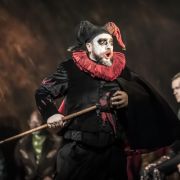
Baritone George Petean took the title role, giving a performance that blended fury with a deep pensive melancholy. His Rigoletto is bitter, spitting imprecations against courtiers, but in his Act 1 duet with Gilda he brought out the abiding sorrow of lost love, while in his Act 2 confrontation with the courtiers he wrung the text for pathos. His baritone is not a dominating instrument, but was well projected and showed integrated registers, with a bark to the bottom and an evenness at the top.

It helped, of course, that in much of his music he was singing opposite the Gilda of Aida Garifullina, whose soprano, after a slightly undercooked showing in “Filgia! Mio padre!” dazzled in a perfectly judged “Caro nome”, sung with commendable coloratura and a pearly tone. From the first zesty flush of love, to the trauma she undergoes in Act 2 – rocking, head in her arms as she suffers through the recollection – and then that awful moment of self-awareness as she resolutely steps forward to die for the man she knows is unworthy of her sacrifice, Garifullina ran us through the full gamut of emotions.
As the Duke, Iván Ayón Rivas’ performance was mixed; two of the biggest moments – “Questa o quella” and “La donna è mobile” – were lacking, the former subdued and clumsily dispatched, the latter a touch brittle. Elsewhere, particularly in Act 2, his tenor bloomed, with fine rounded top notes and a sense of power underpinning it. There was something too of the cypher to him – perhaps inevitable, given the characterisation – but I never found him entirely credible. William Thomas’ Sparafucile was seedy and sepulchral, offering both death and debauchery in redolent tones, while his pimped sister was sung by Anne Marie Stanley, whose husky tone savoured Maddalena’s text. Blaise Malaba was an unimposing Monterone who struggled to make a vocal impact.

In the first scene, Elder’s tempi seemed lethargic, focusing on detail at the expense of dynamism, but save that, he drew a terrific performance from the house band, with some particularly fine brass playing. Strings were golden and delicate, noticeably strong in the Act 2 duet between Rigoletto and Gilda. An excellent way to celebrate a lifetime’s experience with both the composer and this opera house.