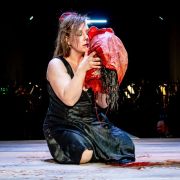
As the spiritual home of British boxing, York Hall in London’s East End has seen some ding-dong battles over the last century, but a year ago it staged an epic operatic slugfest – the Ring cycle. After the 15 hours of Wagner, Regents Opera now goes small scale – at least in terms of length – for its latest bout in Bethnal Green: Richard Strauss’ biblical bloodfest, Salome.

At just 100 minutes without an interval, it seems a modest slip of an opera, but there’s no lack of ambition here. It is directed by playwright and actor, Mark Ravenhill, with choreography by Aletta Collins. The glossy programme contains an excellent (reprinted) essay by Alex Ross, no less, whose book The Rest is Noise begins with Salome. For a fringe outfit, Regents Opera punches above its weight.
Ravenhill establishes an East End gangster vibe before the show. Everyone’s waiting for “the boss” to show up to his birthday party and the pre-show entertainment including canapés, a string quartet and a stripper. The boxing bell rings – seconds out! – and the first music we hear is not the familiar clarinet slither, but a chorus of Happy Birthday ringing out off-stage as Herod enters, wearing his party crown. John the Baptist, hooded, is bundled in and thrown into a shallow cistern below the central stage which juts out, like a catwalk, through the hall.

Once the music begins – in Nigel Shore’s brilliantly effective chamber reduction for just 24 players where the greatest loss is in the slim string section – the action is pretty faithful to the libretto. Freddie Tong’s self-flagellating Jochanaan, sturdily sung although a few rocky top notes taxed him on opening night, is on stage a lot of the time. He gives a hollow laugh when he hears Salome demanding his head as her price for dancing for Herod.
Narraboth, sung with power and presence by tenor James Schouton, dies by slurping from a bottle of bleach, vomiting from the side of the stage. In white suit and floral shirt, Robin Whitehouse’s Herod lacks a touch of mafia menace, his tenor featherweight, although he prattled the text with conviction. Mae Heydorn’s Herodias is a terrific creation, vamping it up, her mezzo crackling and cackling with character. Davide Basso was the pick of the bickering Jews, here Herod’s hangers on, with Felix Kemp a persuasive Nazarene. Conductor Ben Woodward maintained a tight grip on the score, his woodwind players enjoying their moments in the spotlight.

Strauss’ opera stands or falls by the soprano taking the title role. In the first night cast, Kirsty Taylor-Stokes landed the evening’s knockout punch. Initially sporting a Guns N’ Roses T-shirt, then later a silky black dress, she played the sulky teen, petulantly teasing and repulsing Tong’s Jochanaan. Her soprano has a silvery top which she used to great effect. Her lowest notes missed a real growl, but her demand to Herod, “Gib mir den Kopf des Jochanaan!” hit the mark and she had the vocal chops for the final scene, with some ecstatic quiet notes too, although – singing with her back to some of the audience in-the-round – some wouldn't have particularly benefited from that softness.

Collins choreographs the Dance of the Seven Veils as something between a tease – winding up Herodias by stealing her heels – and an act of self-pleasure, rubbing herself with the bag that had been over Joachanaan’s head. When her prize is delivered on its silver charger, it drips with blood. The other characters are suitably repulsed, as are the audience, two of whom decided enough was enough and quietly departed. It’s good to know that, 120 years on, Strauss’ opera still retains some of its shock value.