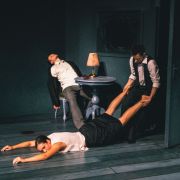
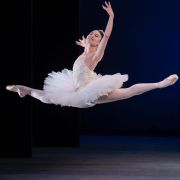
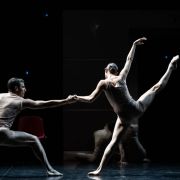
This winter season, the Junior Company of the Dutch National Ballet performed their mixed programme to a full house in the Rabozaal at the International Theatre of Amsterdam. The Junior Company is comprised of 16 talented young dancers from across the globe, many of whom either enter the Dutch National or join other prestigious companies with invaluable professional experience under their belt. In short, these young dancers are often the stars of tomorrow.

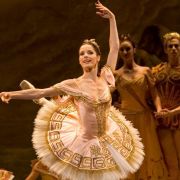
Under the directorship of Ernst Meisner, Ballet Beats was an evening of impressive firsts. The night began with George Balanchine’s Allegro Brilliante. Set to Tchaikovsky’s Piano concerto no. 3, the fifteen-minute piece is quintessential Balanchine. Bold movements, flashy foot work and quick turns, if Allegro Brilliante were a pop album, it’s “all bangers no skips”.
Annabelle Eubanks and Edward Cooley were a delight in the lead roles. Cooley embodied a poetic quality in his physicality and facial expression, and his long limbs complemented Eubanks’ elongated port de bras. The two leads were equally matched in poise and confidence by the four corps de ballet couples who, in Balanchine fashion, barely left the stage.


Balanchine’s musicality is unparalleled, and the dancers were well-rehearsed and galvanized to perform with gusto. Perhaps it was her American training, but Amber Skaggs seemed to bring the right attack to the movements throughout, especially during the first dance sequence for the four corps women.
The Rabozaal is a fairly small auditorium. Performing any classical ballet under the glare of white stage lights in close proximity to the audience would be an intimidating feat for any dancer. Hats off to the ensemble for their unwavering technique and softness in their landings. Their near silent breath work alone deserved applause.

The Junior Company’s interpretation of Allegro leaned more toward sweetness than Balanchine’s signature sass. Now that the ballet is in the Dutch National’s repertoire it will be interesting to see the piece performed with more seasoned artists.
If there was any sense of nervousness from Allegro, it quickly subsided once the company ditched the metaphorical tutus for three world premieres that pushed the art form in new directions, some more successful than others.
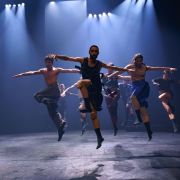
Joshua Junker’s You don’t have to be good set to a stirring, pulsating score by Adam Vincent Clarke evoked a more reflective tone for the dancers to embody. Junker’s hip hop influenced dance language is self-assured and fits neatly into the existing contemporary dance landscape. The second section was particularly contemplative, with dancer Jenson Blight movingly engaging with a series of dance partners. Junker has a good sense of space and in collaboration with lighting designer, Wijnand van der Horst, was able to create a compelling vibe, with a light installation that added additional depth and atmosphere.

Arielle Smith’s Duo explored the emotional tensions between a trio of couples. Duo brought a more playful contribution to the programme, buoyed by the jazzy, Latin remixes of classical music by the Klazz Brothers. I appreciated the gender non-conforming pairings. Javier Cubero was a standout with his supple upper body articulations and exceptional extensions in his dance with Blight. Additionally, John Murch and Léa Sauvignon beautifully manoeuvred their duet’s bold partnering and emotional intensity. At times, Duo felt more like a show piece for the dancers to present their tricks and high kicks and the spicy syncopated music seemed at odds with Smith’s legato movements. It will be interesting to see how Smith develops her choreographic muscle in years to come.


Arguably the strongest of the three new contemporary works, Mthuthuzeli November’s In Your Footsteps, which used most of the Junior Company, aptly closed the evening’s programme. Beautifully costumed in identical long flowing skirts designed by Oliver Haller (kudos for Haller and his team for executing all the costumes for the entire programme), the six male dancers and seven female dancers embarked on a twenty-minute journey that negotiated European classical technique with African movement that aimed at decolonizing Western ideologies of ballet.

There were shades of Giselle and Rite of Spring with Sophia Bielik portraying the protagonist with a fierce elegance and maturity. Amongst the company's strong talent, she is one I will be keeping my eye on in the future. Both Rosa Lidia Cabreri Nuesi and Darius Tamosi were also two dancers who felt equally grounded in November’s work.
The evening seemed slightly asymmetrical in its classical/contemporary ratio but overall, the night was well curated, beginning and ending with its strongest offerings. I certainly hope to see more work by November, maybe with the main company, when Ernst Meisner becomes the Artistic Director of the Dutch National Ballet next season.