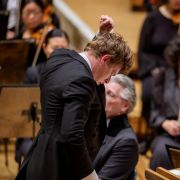
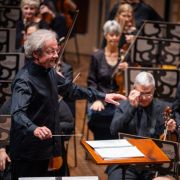
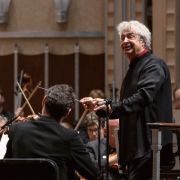
For his New York Philharmonic appearance, composer-conductor Thomas Adès selected an ambitious quartet of works spanning the 20th century. None of the works were familiar, but each offered a unique voice, musically and thematically, and the evening both challenged and delighted the audience as thoughtful programming ought to do.

The banner event was the return of Yuja Wang who came armed with the ebullient Piano Concerto no. 1 by Einojuhani Rautavaara. Though dating from 1969, this weekend counted as its NY Phil premiere. The concerto burst to life with textures well-suited to Wang’s effervescent pianism. Massive tone clusters in the right hand (and later for the right arm) were underpinned by the left hand’s rapid runs, drawing out a rich color palette. Flurries of double octaves put the work squarely in the tradition of the grand Romantic piano concerto, though refracted through a modernist lens. Like a supernova, the first movement closed in ecstatic form.


A central Andante was marked by a solemn procession. The textures of the opening resurfaced, and I was struck by the liquid fluidity of Wang’s playing. The scoring puts the piano front and center, though the orchestra supported her well with additional splashes of color. The brief finale was sparkling and rhythmically-driven – drawing apt comparison to the finales of the piano concertos by Gershwin or Ravel. Wang indulged with a pair of encores, both by composers who fit the program’s timeframe. In Philip Glass’ Etude no. 6, I liked the way she subtly varied its hypnotic repetitions. And a Shostakovich transcription left one in awe with its dazzling display of octaves.
Preceding the concerto was another work receiving a long overdue NY Phil premiere, Charles Ives’ Orchestral Set no. 2. Though completed in 1919, it still feels remarkably forward-thinking. A multitude of ideas unfolded simultaneously, yet under Adès’ sharp baton, themes emerged with clarity, not cacophony. The central segment was of dizzying rhythmic complexities (and what the excellent program notes memorably described as “cubist ragtime”). In its kaleidoscopic orchestration, the vigor of a brass marching band was conveyed. The final movement dealt with the tragic news breaking of the sinking of the Lusitania. An aural richness created an utterly unique soundscape, from the lonely bellows of an accordion to the ghostly murmurings of an offstage chorus (Exigence Vocal Ensemble).

The latter half was a homecoming to the Philharmonic, with two works the ensemble commissioned in 1999 as part of an initiative entitled Messages for the Millennium. Kaija Saariaho’s Oltra Mar is cast in seven movements, alternating between wordless vocalizations and sung texts. Here Exigence was joined by the University of Michigan Chamber Choir, a group with a longstanding devotion to contemporary works. Crashing beginnings imitated the roiling waves with vivid imagery. The texts set in the even-numbered movements were culled from diverse sources, and spoke of love, death and the passage of time – disparate, but disconcertingly coherent.


Adès himself had the final word as composer. America: A Prophecy was the precocious work of a 28-year-old. In 2024, he appended an additional movement which somewhat softens the dark vision he had in his youth. Matters began deep in the Yucatán, with a text that spoke to the terrors of colonialism. Soprano Anna Dennis had a voice of deep resonance that offered order and reason amidst the chaos of the combined choruses. The subsequent section was chilling in its evocation of bloody defeat, ending with a funereal chord progression.
In the revised version, matters then cautiously emerged from the ashes. This was Adès’ strongest writing, evidencing his compositional growth, ending the work on a meditative note.