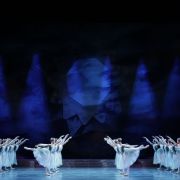
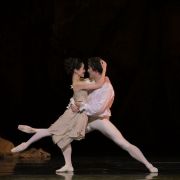
City Lights, Charlie Chaplin’s beloved 1931 film, received its first-ever ballet adaptation by Alastair Marriott for the National Ballet of Japan. Marriott had previously created his acclaimed version of Giselle for the company in 2022, which received rave reviews during the company’s London tour last summer. City Lights is his second creation for the company.

Marriott’s idea of creating a ballet based on a silent film proved to be a perfect match, as ballet is, in essence, an art form without words. Securing the rights to use Chaplin’s original score was another key to the ballet’s success, along with the support of the Chaplin Office in Paris. Timothy Brock, an expert on Chaplin’s music, adapted the score for orchestral performance and composed additional music, all of which was performed magnificently by the Tokyo Philharmonic Orchestra.
The story of the Little Tramp, a wanderer who encounters a blind flower girl and tries to help her despite being penniless, was told beautifully through masterful staging, superb dancing and splendid designs. While remaining largely faithful to the original film, the production captured its heartwarming message and spirit.


Marriott proved highly adept at transforming this timeless masterpiece into ballet. Covering almost all the episodes in the original film, he cleverly structured the production so that the story and plot remained easy to follow, even for those unfamiliar with the film. The captions at the beginning of each scene paid tribute to the style of the original silent film. Dick Bird’s stunning designs – including the stylish Art Deco interiors of the millionaire’s house, the 1930s jazz-age nightclub, a backdrop of New York City skyscrapers that shifts in tone from morning to night, the boxing club and the plaza where the Flower Girl sells her flowers – evoked the atmosphere of the original black and white film while introducing a vivid palette of colour.
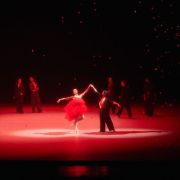
The opening tableau, featuring the 24 members of the corps de ballet portraying citizens attending the unveiling of a monument, added a lively touch to the production. These citizens reappeared at various points throughout the ballet. Several delightful dance sequences paid homage to MGM musicals, including a glamorous, Ziegfeld Follies-style nightclub revue featuring a sizzling pas de deux by a movie-star couple. Other highlights included the Little Tramp dancing with street cleaners and a delightful rain-dance sequence reminiscent of Singin’ in the Rain.

The ballet also featured some impressive mime sequences. One particularly comical episode showed the Little Tramp rescuing the millionaire from a suicide attempt, after which the two become friends. The slapstick boxing match, in which the Tramp unsuccessfully tries to earn enough money to restore the Flower Girl’s eyesight, was hilarious. The millionaire’s wicked maid and her lover, the butler, also provided plenty of comic relief as they plotted to murder their employer.
Yet the ballet’s greatest achievement lies in how Marriott uses dance to tell the story of the relationship between the Tramp and the Flower Girl. Their first encounter was deeply touching. As the Tramp guides the blind girl and introduces her to the world around her, their duet gradually opens up new possibilities for her, allowing her to take larger steps and suggesting how her world is expanding. Their final duet was bittersweet. Reimagining the ending of a film whose final scene is regarded as one of the most romantic in cinema history was a bold choice. Marriott transformed it into a heartbreaking pas de deux that revealed the characters’ delicate and complex emotions.


The magnificent production and Marriott’s astute direction, developed in collaboration with Jonathan Howells, were complemented by performances of great sincerity and sensitivity. The dancers brought two of cinema’s most iconic characters convincingly to life.
Kosuke Okumura captured Chaplin’s distinctive physicality with remarkable precision, from the way he walked, to his subtle facial expressions. Rather than simply imitating Chaplin, he incorporated flawless ballet technique, including leaps and turns, into his performance, lending the character both grace and dignity. Yui Yonezawa’s subtle yet detailed acting and movement conveyed the Flower Girl’s blindness and golden heart. Through her encounter with someone who genuinely cared for her, the girl gradually discovered a wider world, began to enjoy life and gained confidence.

The emotions expressed in their duets were profoundly moving. There was hardly a dry eye in the theatre when the girl finally revealed to the Tramp that she had regained her sight.
Masahiro Nakaya brought charisma and charm to the role of the drunken millionaire, while Miho Naotsuka was both hilarious and irresistibly sensual as the wicked maid. The dazzling virtuosity of the glamorous movie-star couple, Yuri Kimura and Yudai Fukuoka, also contributed greatly to the production’s success. The ensemble delivered the comedy of City Lights with impeccable timing and panache, while the frenetic, fast-paced jazz dancing in the nightclub scene was executed with impressive precision.

The ballet City Lights has proved to be a resounding success. Chaplin’s story is not merely charming and heartwarming; it also highlights the contrast between poverty and the lavish, decadent lifestyles of the wealthy, a theme that resonates strongly with contemporary society. This production successfully translates Chaplin’s spirit into a ballet for the 21st century, bringing its characters vividly and tenderly to life. It is a work that even newcomers to ballet can enjoy, laugh and cry over.
I am certain that this production will be a valuable addition to the repertoire and deserves to be seen by audiences around the world, brought to life by the outstanding performers of the National Ballet of Japan.