When Justin Peck’s Copland Dance Episodes opened at the Sydney Opera House on Friday night, it arrived in the wake of a ‘Blue Tsunami’ of Democratic victories in the American midterm elections. It was a resounding repudiation of what US Senator Jon Ossoff (like the performance, another Australian-American love child) described as “the depravity, corruption, and incompetence of the failed lame duck president”. Set to the sweeping, unmistakable Americana of Aaron Copland’s music, Peck’s neoclassical ballet imagines a world where individuality and collective purpose coexist, and optimism triumphs over division. In a country whose political fractures have recently seemed irreparable, its vision of unity, colour and shared possibility suddenly felt a little less fanciful.

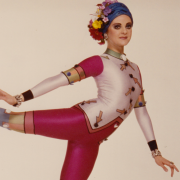
While the political tide in America had turned a single shade of blue, Peck’s world explodes in a riot of colour. That renewed exuberance finds its most immediate expression in Ellen Warren’s gloriously vibrant costumes: blocks of pop-colour designs, explosions of saturated pinks, magentas, turquoise, lime green, orange, red, white and blue, with no two colours exactly alike. This chaos-rainbow is thrown into sharper relief against Jeffrey Gibson’s creamy, minimalist set, and Brandon Stirling Baker’s cool, dramatic lighting.


Copland’s music, particularly Appalachian Spring, has those expansive melodies and spacious orchestral textures that seem to open up vast frontier landscapes, punctuated by bold percussion and jazz-inflected rhythms that land it squarely in the 20th century. Were it not for the fact that Copland Dance Episodes premiered only three years ago in New York City, with The Australian Ballet being the first to perform it elsewhere, it could easily be mistaken for a mid-century American creation. There is something distinctly Broadway about its energy – unsurprising given Peck’s love for musical theatre; he choreographed Steven Spielberg’s remake of West Side Story in 2021, and has garnered three Tony Awards, so far.

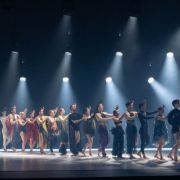
There is something, too, of Norton Juster’s 1961 children’s fantasy classic The Phantom Tollbooth about Peck’s creation: the same exuberant sense of discovery; the same delight in the possibilities of colour and movement as their own language; the same psychedelic undertone. Just as Milo’s journey through the Kingdom of Wisdom transforms abstract ideas into fantastical landscapes, Peck takes the familiar musical language of Copland and conjures a world of vibrating patterns and kaleidoscopic colour. Dancers assemble and disperse, and geometric formations dissolve into playful disorder. Warren’s costumes draw that connection keenly, transporting us straight to the fantastical kingdom of Chroma the Great, who conducts rainbows and sunsets and where music, movement, geometry and colour merge in a glorious synesthesia.

Judging by the production’s exuberant promotional material, I had anticipated 75 minutes of almost relentless, high-octane dancing. But Peck is far too astute a choreographer to sustain such a frenetic pace without respite. Interspersed with the explosive ensemble sequences are passages of surprising sentiment and contemplation, where the tempo softens and the dancers (and audience) are given room to breathe. Even the wildest trip needs some quiet time.


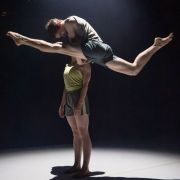
These moments emerge most memorably in the pas de deux, particularly between Isobelle Dashwood and Jeremy Hargreaves, two taller dancers who luxuriate in elongated arabesques, juicy fondues and indulgent port de bras. Far from interrupting the momentum, these interludes provide essential contrast, ensuring that each new burst of exuberance feels genuinely exhilarating.

Speaking of renewed vitality, Riley Lapham, whose journey has included a prolonged battle with long covid that left her bed bound for months shortly after being named Telstra Ballet Dancer of the Year, is a standout. Lapham flies across the stage in dynamic diagonals and fluid turns with an infectious vitality that seems entirely at home in Peck’s world. Yuumi Yamada is another quick-fire dancer whose speed, intelligence and technical finesse seem tailor-made for Peck’s choreography. Precious Adams makes it all look like a breeze, while Cameron Holmes brings charisma and commitment. I was disappointed to miss Samara Merrick on Sydney’s opening night; she, too, would surely shine in this style.

While it’s a pleasure to see The Australian Ballet having so much fun on stage, the performance would benefit from greater technical precision, discipline and synchronicity in the ensemble sections, particularly among the men. Peck’s intricate, geometric patterns and rapidly shifting formations demand a collective exactitude that was not always evident.
Those shortcomings aside, Copland Dance Episodes is a fresh, sunny, joyous celebration of movement, bursting with an irrepressible joie de vivre and faith in better days ahead.