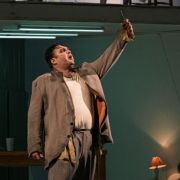
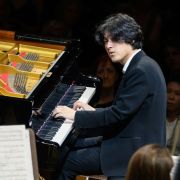
How much relevance could the execution of 16 nuns in France 230 years ago have for today’s world? Plenty, according to a new production of Dialogues des Carmélites at the State Opera in Prague. Director Barbora Horáková has recast Poulenc’s historic tragedy as a memorial to persecuted women across the ages who suffered “the loss of freedom, dignity and identity”. It’s an admirable and ambitious undertaking that doesn’t always work.

Part of the problem lies in the concept. Though Carmelites is set in a time of great political ferment that triggered an anti-clerical rampage, it is not primarily a political piece. It’s the story of how a cloistered religious group deals with the rampage when it comes pounding on their door. Their response is spiritual, not political, which makes for an awkward fit. Seeing military goons abuse women strikes a familiar contemporary nerve, but the nuns are praying, not protesting. As a result, the intent and content of the production don’t always match.


And the structure suggests a third theme: the loss of innocence. Intermission comes after the first act, which is devoted entirely to Blanche de la Force’s decision to withdraw from the world and join the Carmelites, where she learns the harsh realities of cloistered life. In this production she enters as a waif, naïve and dressed like a child (an image reinforced by fleeting appearances of an actual child). Witnessing the anguished death of the Prioress instills a new level of maturity in Blanche that reaches full fruition in the third act. But the first act, standing alone with the focus entirely on her without a whiff of politics or persecution, plays like a different opera.

Throughout the second and third acts, a backdrop of projected photos and videos invokes timeless invasion and oppression. Mostly. There is also religious imagery, including a profusion of Madonnas in Act 2, and a steady stream of hard-to-figure items like insects, dripping blood and a corpse’s feet. Adding to the confusion, the projections are split across multiple screens, sometimes obscured by the props and players. The starkness of Ines Nadler’s set is relieved by square racks of overhead lights that descend periodically to become a lush garden where the nuns toil. It’s a clever arrangement, unfortunately undercut by the lights being bright fluorescents that create a sterile atmosphere. The convent need not be literal, but there’s never any sense of a sacred space.
House regular Jana Sibera carried a heavy load as Blanche, partly because her forte is lighter, more lyrical roles. But what she may have lacked in timbre she made up for in passion, singing her anguished heart out, often while on her knees. She had strong support from emotional performances by several colleagues – Jekatěrina Krovatěva as Sœur Constance, Tone Kummervold as Mère Marie and Tamara Morozová as the new Prioress, Madame Lidoine. As the first Prioress, Markéta Cukrová managed to stay in good voice while suffering through her lengthy, overwrought death scene. Among the limited male roles, Paul Gay cut a commanding figure as Blanche’s father and, after a slow start, Daniel Matoušek offered a persuasive portrayal of her beaten, bloodied brother.


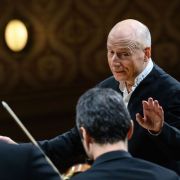
With Hermann Bäumer on the podium, the work in the pit was a marvel, providing much of the color and animation absent onstage. Dialogue largely in recitative gives the orchestra an opportunity to carry the narrative, which Bäumer did with aplomb, creating grim portents, dire moments and continuous drama. In particular, the slashing sounds of the guillotine dropping hit like hammer blows. Just as interesting were the many musical interludes, which featured sterling solos from the brass and woodwinds. Overall it was an impressive combination of finely detailed craftsmanship and evocative atmospherics, knit together by a maestro who knows the score.

For all its flaws, Horáková’s production leaves a powerful impression. There’s no avoiding the horror of the final scenes, in which the nuns are physically abused, stripped and shorn. That this is done by men in military uniforms makes it feel uncomfortably close, the rending music heightening the impact. The singing reached a fever pitch and new lighting effects made the deaths devastatingly final. While the nuns may be willing martyrs, in this finale it’s impossible to see them as anything other than tragic victims.
Ultimately, Horáková’s version of Carmelites may not be the all-encompassing tribute that she had in mind. But it’s close.