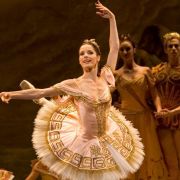
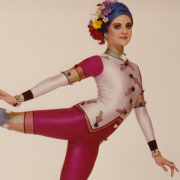
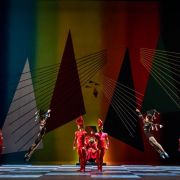
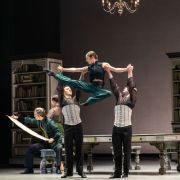
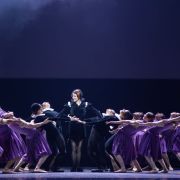
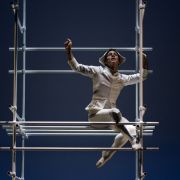
Birmingham Royal Ballet (BRB) opened its spring season at London’s Sadler’s Wells with a double dose of Carlos Acosta’s production of Don Quixote on the afternoon and evening of 23rd April. With only a passing resemblance to the great novel by Cervantes, it is a ballet set in 17th century Spain choreographed in the 19th century for the Bolshoi Theatre in Russia by the French-born Marius Petipa. The music is by the Austrian-born Ludwig Minkus.

There’s probably not much that remains of what Petipa created for the original ballet back in 1869, if any, but what does survive today is a creaking comedy with a rum-ti-tum score that includes a celebrated pas de deux with tons of Spanish clichés along the way. Everyone on stage has a fiery temperament, and the ballet includes not only the ditzy Don and his side-kick Sancho Panza, but matadors preening and strutting their stuff, a ludicrous aristocrat, cunning and devious gypsies who, deep down, have hearts of gold, and women swirling their skirts like flirtatious minxes – you get the picture.


Don Quixote is not a great ballet – some would argue it’s not even a good ballet – but it does require full-blooded Spanish-style dancing alongside classical virtuosity, as well as highly theatrical performances from the entire cast. Although BRB made a good attempt at the work, it’s a corny piece that, I believe, only the Bolshoi can get away with today. Watching the performance on Thursday evening, I found myself missing the hammy chutzpah that the Bolshoi bring to all the Spanish and gypsy dances, as well as their sheer classical bravura.
In his production for BRB, first seen in 2022, Acosta sticks quite closely to the standard version of the ballet, although – like Rudolf Nureyev in his own stagings of Don Quixote – he tends to over embellish the traditional choreography. He has, however, been helped immensely with the look of the ballet through imaginative set and video designs by Tim Hatley and Nina Dunn, especially during the second act when Don Quixote tilts at those famous windmills. I found Hatley’s costumes less attractive, and even less persuasive was Hans Vercauteren’s musical arrangement of the Minkus score, with those familiar tinkly tunes somehow seeming less rhythmic than usual.

Leading the ballet as Kitri and Basilio, the young lovers whom the Don helps to get married against the wishes of Kitri’s father, were principal dancers Momoko Hirata and Mathias Dingman. In everything they did, the couple were step perfect, and I could not fault either for their technical prowess, but their interpretations were low-key and they lacked just the last extra ounce of panache needed to turn excellent dancing into something scintillating. This was true of much of the dancing I saw that evening, including the gentle account of the Queen of the Dryads from Céline Gittens, and the quick-silver Amour of Tzu-Chao Chou during the Don’s “Vision” scene, and also that of Max Maslen as Espada, the matador, and Yaoqian Shang as Mercedes, the street dancer.


In the leading character roles, Rory Mackay was a convincingly “confused” Don Quixote, but both Alfie-Lee Hall as Sancho Panza and Rafael Bejarano Vidal as Gamache (whose face was almost entirely obscured by his blue periwig and yellow wide-brimmed hat) were trying too hard to be funny, without really succeeding. The Royal Ballet Sinfonia’s conductor, Paul Murphy, did the best he could with music that would surely never be played in the concert hall.