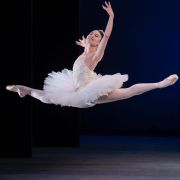
On December 17, 2025, esteemed Dutch choreographer Hans van Manen passed away at the age of 93. Considered one of the great choreographers of contemporary and neo-classical ballet of the 20th century, van Manen’s work continues to be enjoyed by audiences across the globe, performed by the most prestigious ballet companies around the world. Two years ago, Dutch National Ballet was already working closely with van Manen, putting together a programme in recognition of his incredible body of work and his contribution to the art form of dance. The evening’s offerings by the company aptly titled, Hans van Manen in Carré, was both a celebration and deep gratitude to an artist and his work, danced beautifully and performed with care in front of a full house, many of whom knew him intimately and loved him dearly.

It cannot be overstated how the mixed programme of four distinct pieces from van Manen’s oeuvre, in conjunction with his passing, gave the night both weightiness and fragility with an awareness of the fleetingness of life. Dance is such a unique art form in that it continues to be experienced through live bodies in motion, works that persist and exist by the passing of knowledge into physical manifestation, from generation to generation. It is not an art form that can be preserved and hung in a museum, but something that breathes, that lives in the bodies of the dancers who perform it in connection with the audience in a specific moment in time.


The presentation of the evening was striking, in that the floor seating of the Carré was repurposed with black marley to become the stage for the dancers to perform on. This created a unique kind of intimacy between the dancers and the audience who were seated in the round.
Knowing that van Manen chose these pieces and worked closely with these dancers up until his death, Hans van Manen in Carré, for me, felt like a message from the beyond. Throughout the evening, I kept asking myself: what does van Manen wants us to know about him and his work? How does he want to be remembered?

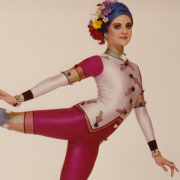
Originally created for Nederlands Dans Theater, Kammerballett was the perfect opening to the night, showcasing van Manen’s playful choreographic palette, where four couples in complementary unitards danced in various solos and duets, highlighting the dynamic tension of human relationships – a recurring theme in van Manen’s work. There is an accessibility to van Manen that should not be confused with simplicity. His work is both conceptual but highly musical and streamlined with clean gestures and lines that extend and somehow feel reminiscent of paintings by Mondrian.
Concert pianist, Ryoko Kondo played with precision that was matched expertly by the dancers. I found Edo Wijnen’s musicality particularly satisfying, especially how he masterfully manoeuvred a series of quick, low jetés in alternating directions. The duets danced by Yuanyuan Zhang with Vsevolod Maiesvkyi and Jessica Xuan with Semyon Velichko were exquisitely performed, with every curve of the spine and spiral pencil turns low to the ground by the women, became almost hypnotic. Salome Leverashvili performed with drama and gusto, bringing a level of complex theatrical depth beyond her years.

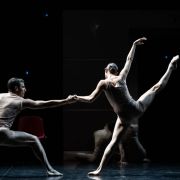
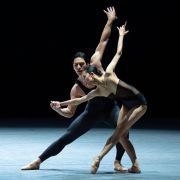
Van Manen seemed to take inspiration from social dancing, particularly the tango. His ballets are often conversations between the dancers in which the audience is privy which was evident in the pas de deux/duet between Riho Sakamoto and Young Gyu Choi in Two Pieces for HET. Through his minimalist dance language, we watched the dancers negotiate between power and intimacy, dominance and submission. Like the tango, van Manen often plays with syncopation in his steps, creating moments of tension through small, sharp gestures and piercing eye contact. Both principal dancers moved with the clarity of a sniper, constantly pushing and prodding each other with their movements.


While all the evenings duets were between men and women, the power dynamics in Two Pieces showcased a genderless competitive spirit where both parties took turns in dominance and acquiescence.

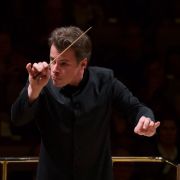
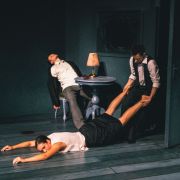
Van Manen was not afraid of a bit of titillation and spectacle. For Two Pieces he put the male dancer in a sheer unitard, exposing his posterior, challenging the gaze of the audience. This became a cheeky (pun intended) thread that connected Two Pieces to the following ensemble work Black Cake, where all the men were costumed in black sheer pants that also exposed their derrières, whereas the women wore tasteful, matching black cocktail dresses. While tension between the couplings was still ever present, the ballet was set in a party scene to bombastic music played by the Dutch National Orchestra, joyfully conducted by Karel Deseure. Here, the dancers leaned into van Manen’s humorous side with Timothy van Poucke and Kira Hilli stealing the show with their comedic duet and drunk acting. While van Poucke’s sleepy-eyed interpretation of a drunkard gave me a chuckle, the quivering lips of a woman nearly in tears by Alexandria Marx truly deserves a slow clap.

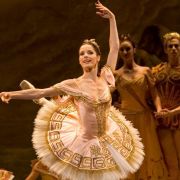
To end the evening, van Manen’s work, Live is truly a work of art. The 1979 work, originally created in the Carré, is a multidisciplinary masterpiece that distils the essence of van Manen’s choreographic genius. Maia Makhateli was the central dancer opening night, who becomes aggrandised through the dynamic relation of the cameraman, Mathieu Gremillet, who records her live and projects her onto a giant screen in black and white from the stage.
Live becomes a portrait of a woman, both onscreen and onstage, and the power of looking, challenging the audience’s gaze. Timothy van Poucke makes his appearance and through the camera, we watch the dancers leave the stage and into the lobby, where the dancing continues and the audience is now watching a kind of cinema verité happening in real time. The stillness, the fragility, the struggle with human connection is all present. When the camera follows Makhateli out of the Carré itself, her back towards the camera as she walks out onto the dimly lit city street of Amsterdam, it just about moved me to tears.