Creating a new opera based on real-life people poses a difficult essential question: How accurate to real life should the story be? Too much literality risks the mundanity of real life intruding. Too much invention, the detachment from the relatable inner truth. The creators of the new American opera Omar surely found themselves confronted with this narrow line to toe, and their toeing was a mixed success.

Omar tells the story of Omar ibn Said, a real person whose story is preserved in his autobiography, written in his native Arabic. Omar was a well-educated Muslim, living in what is now Senegal, who was kidnapped and enslaved in the United States for the remainder of his life. His autobiography formed the basis for the libretto, written by the accomplished American roots musician Rhiannon Giddens. Lyric Opera of Chicago presented the local premiere this past weekend, the sixth of seven co-commissioning organizations to do so. Spoleto Festival USA gave the world premiere in 2022.


Giddens also co-composed the score with Michael Abels, a composer of concert music and, most visibly, film scores for the movies of Jordan Peele (Get Out, Us). Publicity for Omar plays up the disparate genre influences on the music – hymns, spirituals, gospel, bluegrass, African percussion – which sounds like a feathered fish, but the experience of listening is firmly in the Western operatic tradition. Those other musics inform the score of Omar like American folk music informs Dvorak’s New World Symphony.

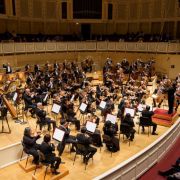
Giddens and Abels’ score is nimble, heartfelt and able (pun intended). Arias that step out of the story for a pensive moment succeed in stopping time, particularly Omar’s mother’s aria and Omar’s recitation and commentary on the 23rd Psalm. The chorus has several shining moments as well, such as a call-and-response spiritual delivery of the text “O Lord, How Long?” and an Amen. A driving 3-3-2 rhythm established in the overture recurs several times and lends some unity to the whole. The score won the 2023 Pulitzer Prize for music.
The tenor Issachah Savage’s performance merits a special call-out. The clarity and projection of his warm, emotionally expressive instrument in the 3,000+-seat Lyric Opera House was remarkable, and his stamina in a show where he rarely leaves the stage impressive.

The libretto in Omar feels lacking in several spots, however, and drags down the stronger music at times. Some of the text comes off too on-the-nose, telling rather than showing, and rhymes can feel like they didn’t brainstorm past the first thought, as in the lyric “Tell your story, Omar, you must / or they will never know, and we will fade into dust.” There are not many plot points in the story, which isn’t a priori a weakness, but when they do occur, they’re dealt with clumsily, as when the apparition of Omar’s mother encourages him to escape just before intermission without sufficient justification, and then when the curtain comes up again, Omar is in jail, apparently having been arrested. The storytelling does not operate at the same level of accomplishment as the music.


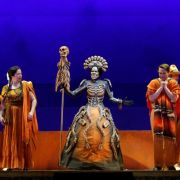
In Kaneza Schaal's staging, the design, too, feels scattered. Elements like a tree draped with diaphanous fabric and skittering Arabic writing are eye-catching and beautiful. But a woodcut-like image projected as the backdrop to the slave ship’s passage seems from a different artistic universe, as does the high-definition cradling hands projected on a scrim during another aria by Omar’s mother – another too-obvious element.

The biggest problem in Omar, though, is the absence of a throughline or central conflict. Is Omar on a journey? Is he in conflict with slaveowners, or American society, or God? Is the opera showing us the preparation of the conditions that lead to the climactic writing of his autobiography? The fact that you could argue yes to any of these means the direction of the story is not clear.
In previous interviews, Giddens has said the character of Julie (Kearstin Piper Brown), who meets Omar at a slave auction and tells him, in words he does not understand to make his way to Fayetteville, is fictional. Julie does provide some narrative connection between the first and second halves of the opera, in motivating Omar to get to the relatively sympathetic (maybe that should read “less unsympathetic”) slaveowner (Kyle Ketelsen) who encourages him to write his memoir.
Is this the greater truth of Omar’s story, that we must preserve and celebrate this unique text he produced? That, circular as it is, is the best answer we’re offered.