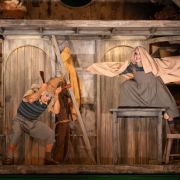
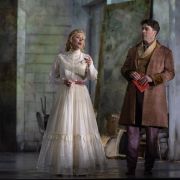
As the orchestra struck up for the overture, the curtain rose to reveal two phalanxes of men in 20th-century gangster attire facing each other with guns outstretched. This striking tableau kicked off Gounod’s take on Shakespeare’s star crossed lovers, Roméo et Juliette, presented by the West Australian Opera in a co-production with the State Opera South Australia and Irish National Opera, directed by London based Rodula Gaitanou, but featuring here an impressive array of home-grown talent.

During the overture, a young girl and boy wheel trolleys onto the apron and proceed to construct statues – I gathered from the programme booklet that they represent the young Roméo and Juliette – and they later dismantle these statues, presumably representing the fate of the lovers; one of those directorial conceits. With the first chorus however we are quickly immersed in the Capulets’ ball, with the participants fill the stage in multi-coloured outfits and glittering masks (costumes by takis, also the sets), and the participants are choreographed so that there is a constant rhythmic swirl to the ensemble numbers.


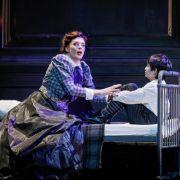
The sets are what you might call abstract if not downright sketchy, with panels featuring shafts of neon light, first green, then red. The most notable feature is a series of flown flats which light up with glittering stars, occasionally descending down side flats towards stage level, a particularly attractive effect. The lovers’ marital bed is a rather uncomfortable looking affair, Frère Laurent hangs out in a veritable plant nursery, but otherwise there are no props to speak of; the production generally relies on colour and the movement of the performers for its impact, and of course Gounod’s music.

The West Australian Symphony Orchestra was able conducted as always by WAO Artistic Director Chris van Tuinen, bringing out the lushness of the score – special mention here to harpist Kira Leigh – and allowing the singers to shine. The West Australian Opera Chorus outdid themselves, with tightly focused singing while performing the quite elaborate choreography. This applied also to the soloists.
Juliette was brilliantly sung by Samantha Clarke, a graduate of the West Australian Academy of the Performing Arts, who then honed her craft in London. After a stunning WAO debut as Violetta in 2022, this is a welcome return; her gleaming lyric soprano is ideally suited to the part, with “Je veux vivre” a perfectly judged exercise in accurate coloratura singing as well as a vivid expression of youthful hope and joyfulness. Her dramatic trajectory was convincing throughout, and in this she was perfectly paired with tenor Alasdair Kent’s Roméo, another WA talent made good in foreign parts. His elegant tenor singing was distinguished by ringing high notes and convincing emotional commitment; this was a pair of lovers you could believe in, and all their duets were a musical delight.


Rising young star of the future Benjamin del Borrello as Mercutio gave us a wonderfully spirited “Mab, la reine des mensonges” with finely judged resonant tone and is the first baritone I’ve seen do a cartwheel on stage. Another entertaining turn was served up by mezzo-soprano Ruth Burke as Stéphano, whose character really only exists to deliver the mocking aria “Que fais-tu, blanche tourterelle” and annoy the Capulets, but she delivered it with great aplomb and rich mezzo tone, leavening the proceedings which of course at this point are getting rather grim.
All other roles were more than adequately filled. Tenor Kohsei Gilkes sang and acted well as the doomed Tybalt, while first appearing in a far from flattering skirt. Fiona Campbell provided her honeyed mezzo voice to the nurse, and managed to bring some humour to the role, while Andrew Foote was a sympathetic Frère Laurent. The unsympathetic elders were well portrayed by Christopher Hillier as Count Capulet and Jake Bigwood as the Duke of Verona.