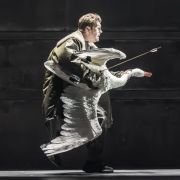
To find one of those moments of pure operatic magic, look no further than the opening of Act 3 of Verdi’s Un ballo in maschera at Opera Holland Park. Amelia is singing “Morrò, ma prima in grazia”, a plea to her husband Anckarström that she may embrace her child before he murders her in fury at her supposed (although, in fact, unconsummated) infidelity. Elin Pritchard was sensational – as she was for the whole evening – her soprano creamy in timbre while filled with drama, the high notes solid, the lilt persuasive. Director Rodula Gaitanou goes slightly off-libretto by having Pritchard actually holding her baby as she sings this, but it works: the purity of Pritchard’s voice in that setting left no room for doubt that Dario Solari’s Anckarström would spare her life: Solari played the role of the conflicted husband to perfection, in spite of some tightness in the voice in his more demanding arias.


It was announced that Matteo Desole had been ill during the day and might not be able to complete the evening, with a replacement being flown to cover that possibility. Clearly, adrenalin won through, because in the event, Desole turned in a creditable performance as Gustavo, the King of Sweden whose courting of Amelia leads to his murder during the masked ball of the title. His vocal power dipped somewhat by the close of Act 2, but he was seemed back to full strength after the interval, displaying a generous bel canto tenor.

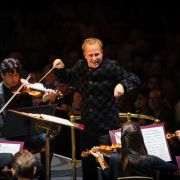
Michael Papadopoulos and the City of London Sinfonia gave a vivid rendition of Verdi’s score, in spite of their relatively small size, bright and breezy in the upbeat numbers, mysterious in the scenes at the home of the psychic Madame Arvidson (Rosalind Plowright clearly adores the role and threw everything into it) lyrical in the tender passages. The score for Ballo is glorious from beginning to end, a finely nuanced alternation of light and shade, and it was beautifully played here.

I wish I could say the same about Antonio Somma’s libretto (and the Eugène Scribe piece on which it is based). Like much of Scribe’s work, it follows the tedious convention that all historical events, of whatever importance, must be the result of a love triangle – and, indeed, that the forbidden love must result from an unexplained and inexorable coup de foudre. But even accepting those conventions, the character of Gustavo is barely credible and so many of the individual lines in Un ballo in maschera run contrary to any dramatic sense that even Gaitanou, one of the most detail-conscious opera directors you’ll find, is unable to inject sense into them and has to reply on hope that you’re not listening to the Italian (or reading the surtitles) too closely.


Gaitanou’s staging starts uncertainly – the courtiers start out in a fencing salle in which the fight direction is decidedly iffy. She chooses the Swedish version of the names (rather than the colonial Boston demanded by the original Italian censors), but there’s no visible Swedishness. Designer takis’ sets feature monumental panelling in dark wood and his costumes are straight out of the 1930s America of Kiss Me, Kate (I half expected the villainous Counts Ribbing and Horn to break out into Brush up your Shakespeare). It’s all easy on the eye and the costumes for the masked ball itself are a delicious riot, from Gustavo and Anckarstöm’s musketeer outfits to Ancient Egypt, a Roman legionnaire and a Samurai-warrior-meets-US-naval-officer combo straight out of Madama Butterfly. The kaleidoscope of shapes and colours perfectly portrays the confusion of the setting that facilitates Anckarström’s murder of Gustavo.

Amongst the smaller roles, Jihoon Kim’s sturdy bass stood out as Ribbing and Rhian Lois made a cheeky, puckish page Oscar: it was noticeable that in the big chorus towards the end of Act 1, these were the two voices that really shone through the thick choral and orchestral texture.
In the end, the evening belonged to Pritchard with an Amelia that overcame any lacunae in the libretto to involve us properly in the drama, backed by an excellent orchestral performance, decent supporting singing and an attractive staging. An enjoyable evening of prima la musica – those more inclined to prima le parole will have needed to set their preferences aside.
This review was updated on 29th July 2026 to correct the musical in which “Brush Up Your Shakespeare” appears.