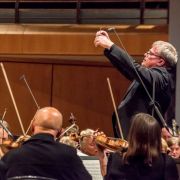
The Royal Liverpool Philharmonic Orchestra under Chief Conductor Domingo Hindoyan opened their latest concert in the Philharmonic Hall with a delightful account of Schubert’s overture to Die Zauberharfe. Forceful chords followed by a graceful melody set us up for ten minutes of pure enchantment, the woodwinds proving particularly adept at making the audience smile.

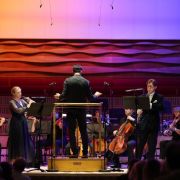
More smiles all round in Saint-Saëns’ Cello Concerto no.1 when Guy Johnston joined the orchestra. The composer had no obvious models for a cello concerto. Haydn and Schumann’s concertos were largely unknown then, while Dvořák and Elgar lay in the future. Saint-Saëns ensures that a relatively small orchestra (fewer horns than in the Schubert and no trombones) is used so sensitively that the soloist is never overwhelmed. After a single orchestral chord Johnston established his presence with a bravura flourish and thereafter the exchange between the soloist and orchestra was sometimes dramatic and sometimes reflective, but they always appeared to be responding to each other. Crucially, when the soloist was playing the focus was on him and the RLPO’s role was in support. The orchestra came to the fore when the cello was silent. Both brought a classical poise to the central Minuet, one of the glories of this unassuming, good humoured concerto. The conclusion was energetic, Johnston using the opportunity to demonstrate his virtuosity in all registers of his instrument. He communicated very directly with the audience. By way of an encore, he and the cellists of the RLPO gave us more Saint-Saëns: an arrangement by Ben Hughes of The Swan.


If Schubert and Saint-Saëns speak directly to their listeners, Bruckner symphonies demand a different approach. Their audiences need to relax and almost breathe more slowly to let the music take hold. With a little patience they can be enveloped in the glorious sound of Bruckner’s rich orchestration, dominated by resonant brass and contrasting with intense strings. This is how I felt in Hindoyan’s performance of the Sixth Symphony, not one of Bruckner’s most frequently performed but one that has its fervent supporters, evidently including Hindoyan. His conducting brought out the warmth of the music; it was as if he was caressing the orchestra in a loving, unhurried manner. Gentle themes in the strings could turn into impassioned outbursts from the brass or an unexpected flute solo. The Adagio took longer to work its magic but by the beautiful last few minutes it was stunning. Hindoyan was no less committed in the Scherzo which was a startling rhythmic contrast to what had come before. The finale brought the symphony to a resplendent conclusion. It felt not like a stop-start series of episodes but a finely crafted whole. The RLPO showed their prowess in every department but the brass took one’s breath away.