This year’s Fall for Dance festival is off to a promising start. I caught the Wednesday show of Program 1. It was a somewhat unusual program, with a pas de deux danced by a pair of leading American Ballet Theatre principals sandwiched between two bold ensemble pieces by modern dance companies. Yet this odd coupling reflects the diversity of styles and world-class dancing on display at the festival this year.

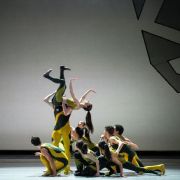
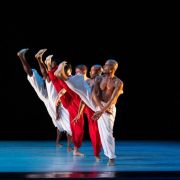
The opening modern number was the New York premiere of Jermaine Spivey’s In the act of undoing performed by A.I.M by Kyle Abraham. The music, which is also by Jermaine Spivey, is electronic and percussive, with some sections marked by lingering tones and others by punctuated silences. I found it intriguingly cool in effect. Spivey’s choreography is an energetic blend of contemporary and street styles that suits the excellent skills and impressive range of A.I.M’s dancers.


This piece also features a spoken-word element that begins in the middle of the first section, when the dancers, in unison, speak a passage of prose that opens with the words, “What begins might be ending completely...” and closes with a similar refrain. The words themselves do not form isolated sentences, nor do the dancers recite them like ordinary speech – instead, they chant the words at a swift, constant pace. Early on, the same passage is projected on the stage, starting from the bottom, and at one point the dancers recite the words in the reverse order (I hesitate to say that either order was forwards or backwards). Their speech felt a bit like a prophecy or perhaps a warning.

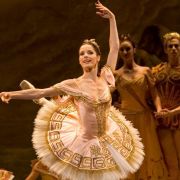
Next was Gerald Arpino's pas de deux L’Air D’Esprit, performed by ABT principal dancers Skylar Brandt and Aran Bell to music by Adolphe Adam. The choreography in this pas de deux is not particularly memorable – I found it a somewhat muddled pastiche of nineteenth-century classics – but it was a fascinating vehicle for Brandt and Bell. These two are not normally paired together at their home company and it is easy to see why. Brandt is tiny, spritely and explosive. Bell is tall, elegant and a gracious partner who is generally reserved for ABT's taller ballerinas. At times, particularly in the alternating solo passages, I wondered if Bell’s more subtle talents were being overshadowed by Brandt’s shimmering pyrotechnics. Though this impression may also reflect an imbalance in the choreography, in which the fleet-footed female variation is a highlight (and a great showcase for Brandt), while the male variation is rather generic.

L’Air D’Esprit features many and varied lifts, often with difficult entrances and Brandt and Bell’s execution of them was by far the most effective aspect of this pairing. They were perhaps the most exciting and dynamic lifts I have ever seen performed in ballet. The lifts moved with such abandon that at one point, in a lift where Bell carried Brandt over his head in a horizontal position, I thought I saw her nearly tip over, placing her hands on his shoulders early to steady herself. See these dancers together if you can.


The program closed with the Martha Graham Dance Company’s performance of Cortege, which the company premiered at the Joyce Theater last year. Choreographed by Baye & Asa to music by Jack Grabow, Cortege is an homage to the mythological Graham classic Cortege of Eagles. Cortege begins with an ominous tableau featuring a line of dancers covered in one long black cloth, which is slowly pulled back to reveal an eight-dancer ensemble. The dancers are warriors, solemn and powerful and throughout the dance they gradually don blank, off-white vests in preparation to face some unseen challenger.

The choreography is entrancing and propulsive, aided by beautiful production and lighting design. Each member of the ensemble was excellent – I struggled to find a standout dancer, or even a few, because each member’s individual contributions were so fully realized. At the conclusion, the dancers return to the line of the opening tableau and the black cloth began to cover them once more – but the lights fall and the piece ends before they disappear completely. Overall, Cortege was the standout piece on this program. So much so, that I look forward to seeing it again.