American Ballet Theatre’s fall season continues with its Neoclassical Works program, featuring works by Sir Frederick Ashton, Kyle Abraham and George Balanchine.

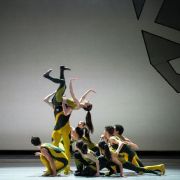
At the opening performance, Birthday Offering, which Ashton famously choreographed for The Royal Ballet's 25th anniversary, has plenty to offer in speed and wit. It opens with an ensemble of seven couples, then transitions to a series of variations for each of the women – originally choreographed for seven star ballerinas of The Royal – meant to showcase their range of styles and talents. The effect is a sort of a neoclassical version of TheSleeping Beauty Prologue with seven variations for several distinct ‘fairies’, here led by Hee Seo – elegant in white.
True to the ballet’s origins, ABT put together an all-star cast, with leading principals Catherine Hurlin, Skylar Brandt and Jake Roxander performing alongside soloists and rising corps dancers. The opening number with the full cast suffered from what may have been a lack of rehearsal time or perhaps some inherent side effects of asking a group of principal and soloist dancers to dance like a corps de ballet. I saw several moments where one couple was a count behind or ahead of the rest, or where dancers’ legs were at dramatically different heights in arabesque.


These issues did improve when the ensemble reunited for the finale. The centerpiece of this ballet, though, is the series of seven variations. I particularly enjoyed Hurlin in the second variation and Fangqi Li in the third. Li has a wonderful blend of clarity and delicacy in her jumps; I'd love to see her dance Giselle one day. Rising corps member Elizabeth Beyer, here in the sixth variation, was impressive despite a botched turn early on, dancing with growing stage presence.

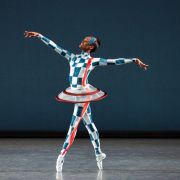
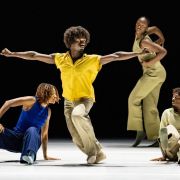
This was my first time seeing Abraham’s Mercurial Son, and it was interesting to see a few weeks after New York City Ballet’s run of his Love Letter on Shuffle. Where the James Blake score of Love Letter is emotionally evocative and effusive, lending a raw vulnerability to the love stories Abraham weaves, the music of Mercurial Son, by Grischa Lichtenberger, is cool and mechanical. In Abraham’s hands, the music’s seeming rigidity presents a range of opportunities.
Sometimes, the dancers take on the music’s harsher, mechanical qualities to great effect, either in sharp tendus that cut across the stage or in fast, tight pirouettes, which were executed with particular style here by a commanding Breanne Granlund. Elsewhere, the dancers appear almost set free by the music’s sheer power – there was Melvin Lawovi, bounding across the stage. Lawovi is really tremendous in this ballet, so much so that I was surprised to find his role was originally choreographed on another dancer. Abraham is one of the finest choreographers in ballet today. Sandwiched between the works of two late masters, Mercurial Son more than held its own.


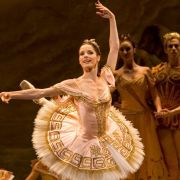
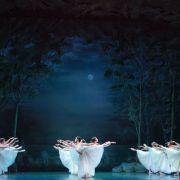
As many Bachtrack readers will know, Balanchine’s Ballet Imperial is performed under a different name at New York City Ballet where it originates. American Ballet Theatre’s version is, ironically given the theme of this program, more classical than neoclassical, with classical tutus, a courtly backdrop and a slightly slower tempo. It is also without some of the signature touches of Balanchine technique, like spotting front during traveling turns. The result can be somewhat strange for those who (like myself) are accustomed to the NYCB version.
Yet in this performance, any strange resonances of classical Balanchine evaporated when Chloe Misseldine emerged. From the opening moves of her variation, and then whenever she was on stage, Misseldine quieted my mind of any doubts that this ballet could be performed any other way. Yoon Jung Seo, one of the company’s rising soloists, was technically strong and pleasant in demeanor, though I found her a bit academic in the upper body. Overall, it was a fine evening of (mostly) neoclassical ballet.